What Types of Tiny Homes Are Available? Wheels, Prefab, Modular and More Explained
By Emily Hartman, Founder & Lead Editor at Tiny Homes Nest. Tiny home owner since 2019.
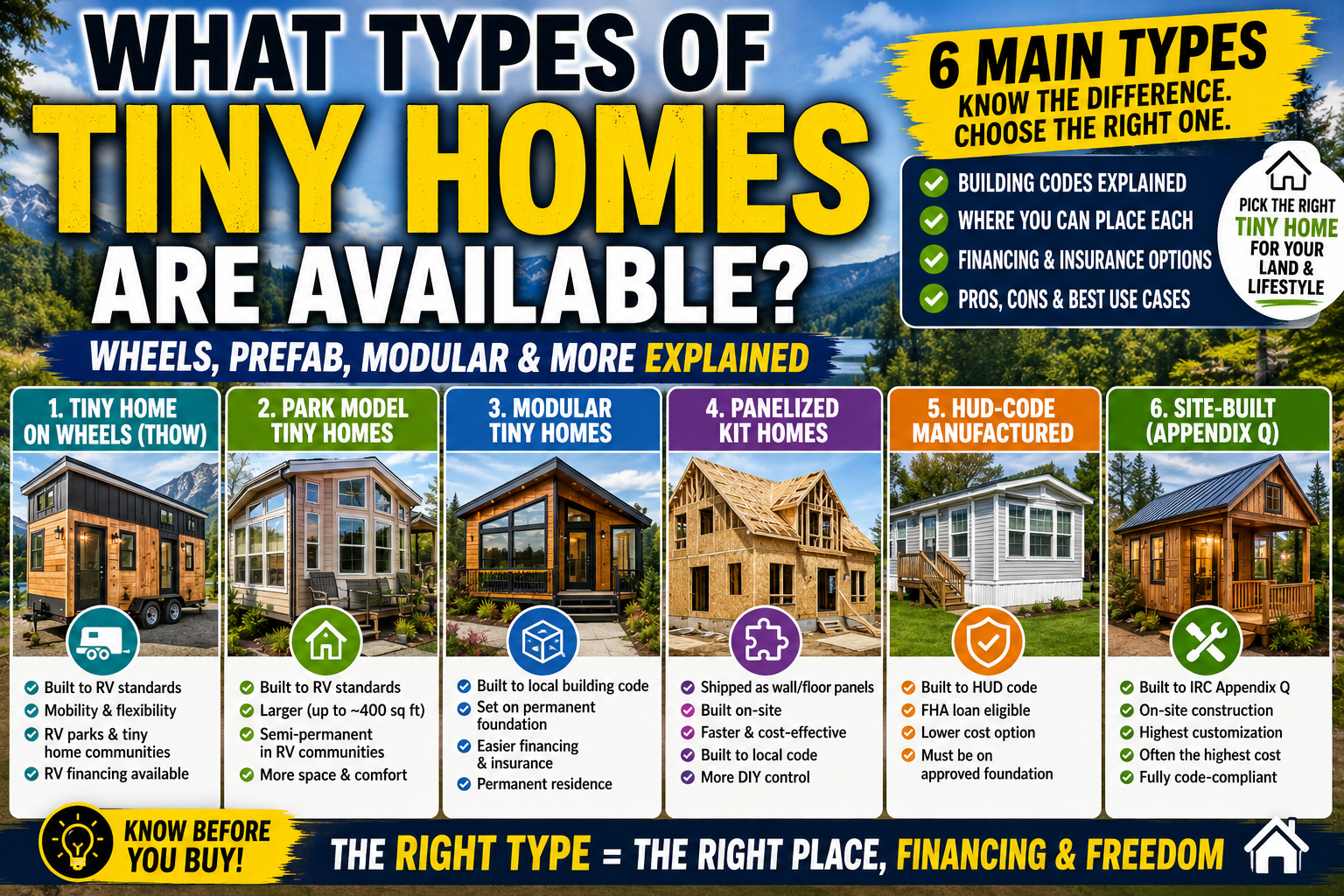
“Tiny home” sounds like one thing. It is actually six very different products, each with its own building code, financing path and legal placement rules. Picking the wrong type before you understand the differences is how buyers end up with a home they cannot legally park, finance or insure. This guide breaks down every major type of tiny home so you can match the right one to your land, your budget and your plans. None of these categories is objectively better than another. Each one simply trades certain freedoms for certain guarantees. Knowing that trade-off before you shop saves months of frustration later.
Quick answer: The six main types of tiny homes are homes on wheels, park models, modular homes, panelized kit homes, HUD-code manufactured homes and site-built homes under IRC Appendix Q. Each one follows a different code, which determines where you can place it and how you can finance it.
What Types of Tiny Homes Are Available? Quick Overview
Every tiny home falls into one of six construction categories. The category matters more than the square footage, since it decides your building code, your financing options and where you are legally allowed to put the home. Two homes can look nearly identical in photos and still belong to completely different legal categories once you look at how each one was actually built and certified. A quick glance at the table below is often enough to rule out two or three categories before you even start browsing floor plans.
| Type | Built To | Best For |
|---|---|---|
| Tiny home on wheels (THOW) | RV industry standards | Buyers who want mobility and fewer zoning barriers |
| Park model | RV industry standards, larger footprint | Semi-permanent placement in RV-friendly communities |
| Modular | Local residential building code | Buyers who want a permanent, code-compliant home fast |
| Panelized kit | Local residential code, site assembled | Buyers who want more control over assembly |
| HUD-code manufactured | Federal HUD manufactured housing code | Buyers who want FHA-eligible financing |
| Site-built (Appendix Q) | Local IRC plus Appendix Q | Buyers who own land and want full customization |
We cover full pricing across every one of these types in our tiny home cost guide, so use this table to narrow down the category before you start comparing exact prices.
Tiny Homes on Wheels (THOW)
A tiny home on wheels is built on a trailer chassis and generally follows RV industry construction standards rather than a residential building code. This is the type most people picture when they hear “tiny home,” largely thanks to its visibility on renovation shows.
Mobility is the entire point. You can relocate a THOW without the permitting process a permanent structure requires. Many owners treat that flexibility as the main draw, whether the plan is a cross-country move or simply the option to leave if a lease falls through. The trade-off is that most jurisdictions do not recognize a THOW as a legal permanent residence on a standard residential lot, so you generally need a tiny home community, an RV park or a property zoned to allow it. RV Industry Association certification also opens the door to RV-style financing, which is usually easier to secure than a loan for an uncertified build. It typically requires a specific weight and construction inspection before a trailer earns the certification sticker.
Park Model Tiny Homes
Park models look similar to a THOW but skew larger, typically capping out around 400 square feet on a single-wide chassis. Like THOWs, they are generally built to RV standards rather than residential code and classified legally as recreational vehicles.
The bigger footprint means more room for a full kitchen, a real bathroom and sometimes a second sleeping area, which makes park models popular for buyers who want RV-style flexibility without living quite as compact as a standard THOW. Most park models are intended for semi-permanent placement in an RV resort or a dedicated tiny home community rather than frequent towing. Check the specific community’s rules before you assume you can relocate one easily later, since many park model owners never move their unit again after the initial delivery and setup.
Modular Tiny Homes
A modular tiny home is built in large finished sections at a factory, then transported and set on a permanent foundation. Unlike THOWs and park models, modular construction generally follows the same local residential building code as a standard house.
That code compliance is the whole appeal. A modular home can typically be financed more like a traditional home, insured more easily and legally occupied as a full-time primary residence on standard residential land, assuming your local zoning allows the square footage. Construction speed is another advantage, since most of the build happens indoors at a factory rather than depending on weather and a local labor schedule. Because the sections travel by truck, though, your site needs road access wide enough for delivery, which is worth confirming before you fall in love with a specific floor plan. Crane availability on delivery day is another detail that catches first-time buyers off guard, since setting a modular section onto its foundation is not a job a standard moving crew can handle.
Panelized Kit Tiny Homes
Panelized construction ships individual wall, floor and roof panels from a factory, which then get assembled on your foundation by a contractor or an experienced DIY builder. Like modular homes, panelized kits are typically built to local residential code once assembled.
The main advantage over modular is flexibility. You are not locked into one manufacturer’s full crew and timeline. The panels can often be adapted to irregular lot shapes more easily than a pre-finished modular box arriving as one or two large sections. This path works best for buyers who already own residentially zoned land and want more hands-on control over the final assembly, whether that means hiring their own contractor or taking on some of the work themselves. Expect a longer overall timeline than modular, since assembly happens on-site rather than mostly in a factory. Weather delays also become a real factor once assembly moves outdoors, something a fully enclosed factory build never has to worry about.
HUD-Code Manufactured Tiny Homes
HUD-code manufactured homes follow a federal construction standard set by the Department of Housing and Urban Development rather than a local residential code. This is the same code that governs traditional manufactured and mobile homes, just applied at a smaller scale.
The federal standard is consistent nationwide, which simplifies financing considerably. Homes that meet HUD code, sit on a permanent foundation and measure at least 400 square feet can qualify for FHA Title I or Title II loan programs. That option is generally unavailable to THOWs, park models or uncertified kits. The 400 square foot minimum is the key limitation here. Anything smaller typically falls into a different category entirely, most often a THOW or a park model instead, which is why true HUD-code tiny homes tend to sit at the larger end of what most people consider “tiny.” Insurance is generally easier to secure for this category too, since insurers already have decades of manufactured housing data to underwrite against.
Site-Built Tiny Homes Under Appendix Q
A site-built tiny home is constructed entirely on location, the same way a traditional house is built, just at a smaller scale. In 2018, the International Code Council added Appendix Q to the International Residential Code specifically to address tiny houses on a foundation under 400 square feet, easing requirements like ceiling height and stair dimensions that the standard code was never designed around.
Appendix Q gives site-built tiny homes on a foundation the clearest path to full legal residential status, assuming your state or municipality has adopted it. You can review the current Appendix Q language directly through the ICC’s code library if you want to see exactly what it changes, including how it allows reduced ceiling heights in loft spaces and more compact stair designs than the standard code permits. Not every jurisdiction has adopted the appendix, so confirm local adoption before assuming it applies to your project. Where it has not been adopted, builders can sometimes still seek approval on a project basis through the code’s alternative materials and design provisions.
Shipping Container and Other Specialty Builds
Shipping container homes deserve a quick mention, since they show up constantly in tiny home searches without fitting neatly into any of the six categories above. A container home’s legal classification actually depends on how it is finished and placed. A container converted and set on a permanent foundation to local code behaves like a modular or site-built home for permitting purposes, while a container mounted on a trailer behaves more like a THOW.
The container itself is a building material choice, not a code category. Treat any container listing the same way you would treat any other type. Ask directly which standard the finished structure meets before you assume anything about financing or placement.
How to Choose the Right Type for You
Four questions narrow the decision faster than browsing floor plans ever will.
- Do you need to physically relocate the home or will it sit in one place indefinitely
- Do you already own residentially zoned land or will you need a community or rented lot
- Does your budget depend on standard financing or can you work with an RV or personal loan
- How much hands-on control do you want over construction versus buying something fully finished
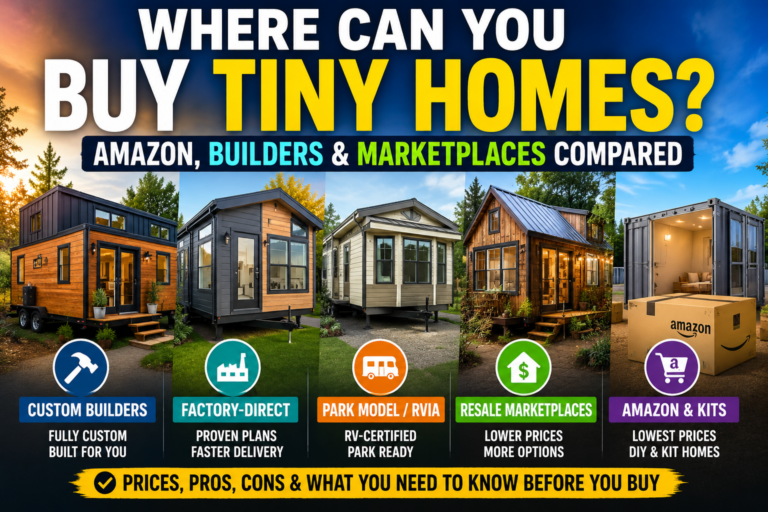
A THOW or park model fits buyers who value mobility or plan to use a tiny home community. A modular, panelized or Appendix Q build fits buyers who own land and want standard financing available. HUD-code manufactured homes sit in between, offering federal financing eligibility without the full custom build process. Once you know which category fits your situation, our guide to where to buy tiny homes walks through the actual purchase channels for each one.
It helps to rank these four questions in order of how much they actually constrain your options, rather than treating them as equally weighted. Land ownership and zoning tend to eliminate entire categories outright, while financing preference usually just shifts your budget rather than ruling anything out completely. Start with the question that removes the most options first. The remaining choice usually narrows itself down to two or three realistic candidates after that.
Frequently Asked Questions
What are the main types of tiny homes?
The six main types are tiny homes on wheels, park models, modular homes, panelized kit homes, HUD-code manufactured homes and site-built homes under IRC Appendix Q. Each follows a different building standard, which affects financing and where you can legally place it.
What is the difference between a THOW and a park model?
Both are generally built to RV standards rather than residential code. Park models are typically larger and intended for more permanent placement in an RV-friendly community, while a THOW is built with more frequent mobility in mind.
Can a tiny home on wheels be a permanent residence?
In most jurisdictions, no, not on a standard residential lot. THOWs are usually legal in tiny home communities, RV parks or on specific properties zoned to allow them. Check local rules before assuming full-time residency is allowed.
What type of tiny home qualifies for a regular mortgage?
None qualify for a standard 30 year mortgage. HUD-code manufactured homes on a permanent foundation can access FHA Title I or Title II loans, though, which come closer to traditional mortgage terms than any other type.
Is a modular tiny home the same as a manufactured home?
No. Modular homes are built to local residential code like a standard house, while manufactured homes follow a separate federal HUD code. The distinction affects financing, insurance and how each type is classified legally.
Do I need a permit for a tiny home on wheels?
Usually not for the structure itself, since it is classified as an RV rather than a residential building. You still need to confirm local zoning allows you to park and live in it at your intended location.
Choosing a tiny home type is really choosing a legal category first and a floor plan second. Get the classification right. Financing, insurance and placement tend to fall into place on their own after that. Get it backward instead. The risk is ending up with a beautiful home you are not actually allowed to live in where you planned.
Still deciding which type fits your situation? Our complete tiny homes guide covers cost, buying channels and everything else you need before you commit to a category. Have a specific build type you are considering? Drop it in the comments and we will help you think through the fit.

4 Comments