Deck Building Cost Guide: Materials and Pricing for 2026
By Emily Hartman, Founder & Lead Editor at Tiny Homes Nest. Tiny home owner since 2019.
A deck is one of the few home improvements where the material you choose can double the price for the exact same footprint. This guide breaks down real 2026 deck cost by material, size and scope, so you know what a fair quote looks like before a single post gets set. Every figure below reflects fully installed cost, framing, boards and labor together, not just the price of decking sitting on a rack at the lumberyard. A deck is also one of the few outdoor projects that genuinely earns its keep, extending livable space during warm months without the permitting complexity a full room addition typically involves.
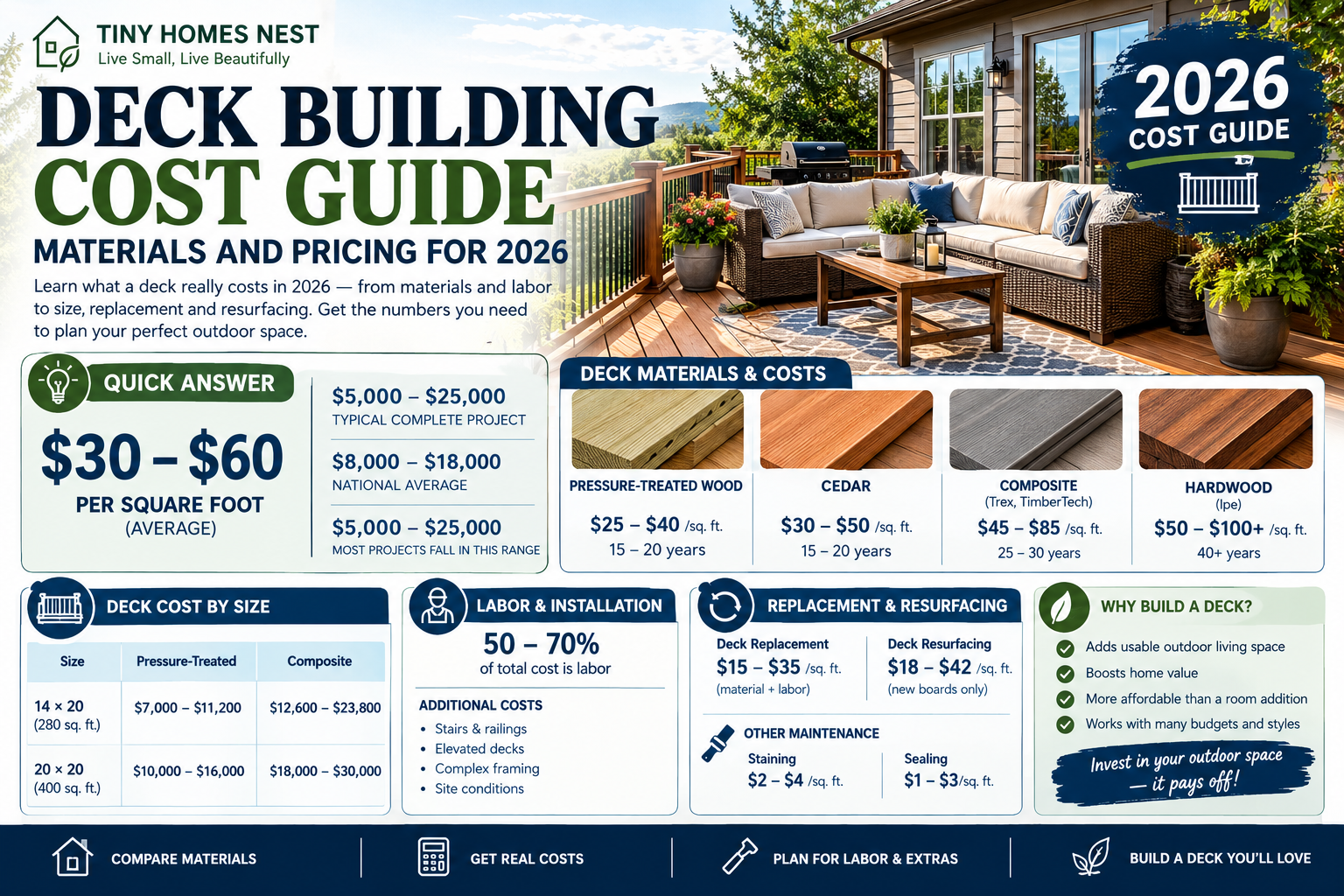
Quick answer: The average cost to build a deck in 2026 runs $30 to $60 per square foot, with a national average around $8,000 to $18,000 depending on size and material. Most complete projects fall between $5,000 and $25,000. Premium materials and larger footprints can push past $40,000.
How Much Does It Cost to Build a Deck in 2026? Quick Answer
Cost to build a deck depends more on material choice than on any other single factor, since the cheapest and most expensive decking options can differ by three or four times per square foot.
A typical deck project installed in 2026 costs $5,000 to $25,000, with the national average landing around $8,000 to $18,000 depending on size and material grade. On a per-square-foot basis, expect $25 to $40 for pressure-treated wood, $30 to $50 for cedar, $45 to $85 for mid-grade composite and $50 or more for premium hardwood. Labor typically makes up 50 to 70 percent of the total bill. This is why two contractors quoting the same square footage can still land on very different totals depending on framing complexity and site conditions. A sloped yard, poor soil conditions or a deck attached at an awkward height above grade can all add labor cost that has nothing to do with the decking material itself.
Deck Cost by Material
Every decking material trades upfront cost against maintenance, lifespan and how the surface actually feels underfoot.
| Material | Cost Per Sq Ft Installed | Typical Lifespan |
|---|---|---|
| Pressure-treated wood | $25 to $40 | 15 to 20 years |
| Cedar | $30 to $50 | 15 to 20 years |
| Mid-grade composite (Trex, TimberTech) | $45 to $85 | 25 to 30 years |
| Premium hardwood (ipe) | $50 to $100+ | 40+ years |
Pressure-treated pine remains the least expensive option, with material alone running $3 to $6 per square foot before installation. Composite decking, Trex being the best-known brand, costs considerably more upfront but requires none of the annual sealing or staining wood demands. Board material for composite alone typically runs $5 to $16 per square foot. Labor adds another $10 to $40 per square foot on top, since hidden fastener systems take longer to install than simply nailing or screwing down wood. Cedar sits in a middle tier, offering natural rot resistance and a warmer look than pressure-treated pine at a modest premium, though it still requires the same periodic staining that any natural wood needs to look its best.
Deck Cost by Size
Two of the most common deck sizes homeowners research, 14×20 and 20×20, translate to meaningfully different budgets once material enters the equation.
| Size | Square Footage | Pressure-Treated | Composite |
|---|---|---|---|
| 14×20 | 280 sq ft | $7,000 to $11,200 | $12,600 to $23,800 |
| 20×20 | 400 sq ft | $10,000 to $16,000 | $18,000 to $30,000 |
Real project examples help ground these ranges. A 120 square foot pressure-treated deck at ground level, no stairs or railings, typically runs $3,000 to $4,500. A 300 square foot mid-grade composite deck raised 24 inches, with stairs and railings, generally costs $13,000 to $19,000. A 500 square foot ipe hardwood deck elevated 6 feet, with a multi-step stair run and custom railings, commonly reaches $30,000 to $45,000. Notice how much height, stairs and railings add to the total even before the material itself changes, which is exactly why two decks of similar size can carry such different price tags.
Deck Installation and Labor Cost
Labor cost varies more by material and structural complexity than almost any other factor in a deck project.
Composite decking specifically costs more to install than wood, since hidden fastener systems and precise board alignment take longer per square foot than traditional face-nailing. Framing complexity, an elevated deck, multiple stair runs, custom railings, adds labor time regardless of which decking material sits on top. A fully installed Trex deck, substructure, boards, basic railing and standard stairs included, typically runs $40 to $80 per square foot, with most standard projects landing around $55 to $70 per square foot. Getting a bid that separates material cost from labor cost makes it far easier to compare two contractors fairly, since one company’s per-square-foot number may already include premium hardware that another lists as a separate line item. Regional labor rates also shift this number considerably, with the Northeast, Pacific Northwest and coastal California consistently running above the national average regardless of material choice.
Deck Replacement and Resurfacing Cost
Replacing an aging deck costs meaningfully less if the existing framing is still structurally sound, since resurfacing skips the most labor-intensive part of a full rebuild.
Resurfacing, keeping the existing frame and installing new boards on top, typically costs $18 to $42 per square foot. It can save 15 to 25 percent compared to a full rebuild when the framing is rot-free and level. A full deck replacement, tearing out the old structure entirely, generally costs the same as new construction for the same material and size, since the framing has to be rebuilt from scratch either way. A contractor should inspect the existing framing and footings before quoting resurfacing specifically, since hidden rot or undersized footings can turn an apparent bargain into a full rebuild once work actually begins. Insisting on this inspection before accepting a resurfacing quote protects you from a mid-project surprise that no homeowner wants to discover once boards are already coming off.
Deck Repair and Staining Cost
Not every deck problem requires full replacement. A damaged board or a faded finish are both far cheaper fixes than tearing out the whole structure.
Replacing individual deck boards typically costs a few hundred dollars for a handful of boards, scaling up with the number of boards affected and how accessible they are. Staining a deck typically costs $2 to $4 per square foot or roughly $600 to $1,200 for an average-sized deck. This should happen every one to two years on pressure-treated wood to prevent warping and cracking. Composite decking never needs staining or sealing at all, which is one of the primary reasons its higher upfront cost narrows over time compared to wood.
Composite vs. Wood: Which Costs More Over Time?
The material with the lower price tag today is not necessarily the cheaper option once you account for a full ownership timeline.
Pressure-treated wood costs less upfront but needs sealing or staining every year or two and typically lasts 15 to 20 years before board replacement becomes necessary. Composite decking costs more upfront but carries a 25 to 50 year warranty against fading and staining, with essentially no ongoing maintenance cost. Composite decking typically breaks even with pressure-treated lumber around year 12, once the cumulative cost of annual sealing and staining catches up to the higher initial composite price. Homeowners planning to stay in a home long-term generally see composite pay off. Those planning a shorter stay often find wood’s lower upfront cost makes more financial sense instead. Resale value adds another wrinkle to this decision, since a well-maintained wood deck and a low-maintenance composite deck can both appeal to buyers for genuinely different reasons.
Deck Safety: What Every Homeowner Should Know
A deck’s most important safety feature is also its least visible. It deserves attention regardless of which material sits on top.
The ledger board, the piece connecting a deck directly to the house, causes roughly 90 percent of deck collapses when improperly attached. Modern code requires bolts or lag screws rather than nails at this connection, along with proper flashing to prevent water damage behind the ledger. The American Wood Council publishes the prescriptive residential deck construction guide that most local building codes reference directly, covering ledger attachment, footing depth and joist spacing in detail. Any deck built before 2009, when stricter ledger requirements became widespread following a fatal collapse, is worth having professionally inspected even if it shows no obvious signs of damage. A gap between the ledger and the house, loose bolts or water staining on the siding below the deck are all signs worth taking seriously rather than waiting to see if the problem resolves itself.
How to Use a Deck Cost Calculator
Online deck cost calculators and estimators provide a reasonable starting range, though they cannot account for your specific site conditions or local permit requirements.
Enter your exact dimensions and preferred material if the calculator asks for them. Treat the resulting number as a planning figure rather than a firm quote, though. Confirm whether your project requires a permit before finalizing a budget, since most jurisdictions require one for any deck attached to the house or elevated more than a minimal height above grade. Get at least three written, itemized bids that separate material, labor, footings and any railing or stair costs into their own line items, since a single lump-sum number makes it difficult to compare two contractors on equal terms. Ask each contractor directly whether their bid assumes existing framing can be reused, since that single assumption can shift a quote by thousands of dollars in either direction.
Frequently Asked Questions
How much does it cost to build a deck?
The average cost to build a deck in 2026 runs $30 to $60 per square foot, with most complete projects falling between $5,000 and $25,000 depending on size and material. Larger decks and premium materials can push well past that range on either end.
How much does a composite deck cost compared to wood?
Composite decking typically costs $45 to $85 per square foot installed, compared to $25 to $40 for pressure-treated wood. Composite costs more upfront but eliminates the ongoing sealing and staining wood requires.
How much does a 20×20 deck cost?
A 20×20 deck, 400 square feet, typically costs $10,000 to $16,000 in pressure-treated wood or $18,000 to $30,000 in composite materials like Trex, depending on railing, stairs and site conditions.
Is it cheaper to resurface a deck or replace it entirely?
Resurfacing, keeping the existing frame and adding new boards, typically costs 15 to 25 percent less than a full replacement. This applies only when the existing framing is rot-free and structurally sound, though.
How often does a wood deck need to be stained?
Pressure-treated wood typically needs staining or sealing every one to two years to prevent warping and cracking. Composite decking never requires staining at all.
What causes most deck collapses?
Roughly 90 percent of deck collapses trace back to an improperly attached ledger board, the connection point between the deck and the house. Modern code requires bolts or lag screws rather than nails at this joint.
Deck cost comes down to matching material lifespan and maintenance to how long you actually plan to enjoy the space, not just comparing the lowest quote per square foot. Get the ledger board and framing inspected on any existing deck before assuming a quote for resurfacing is accurate. Always request an itemized bid before committing to a contractor. A little diligence upfront on both fronts, safety and price, tends to pay for itself many times over across the life of the deck.
Have a specific deck size or material in mind? Drop it in the comments and our team will help you think through a realistic budget. Browse our full Home Improvement collection for more room-by-room and project-by-project cost guides as they go live.