
Water Softener Installation Cost in 2026: Unit, Labor and Salt Prices
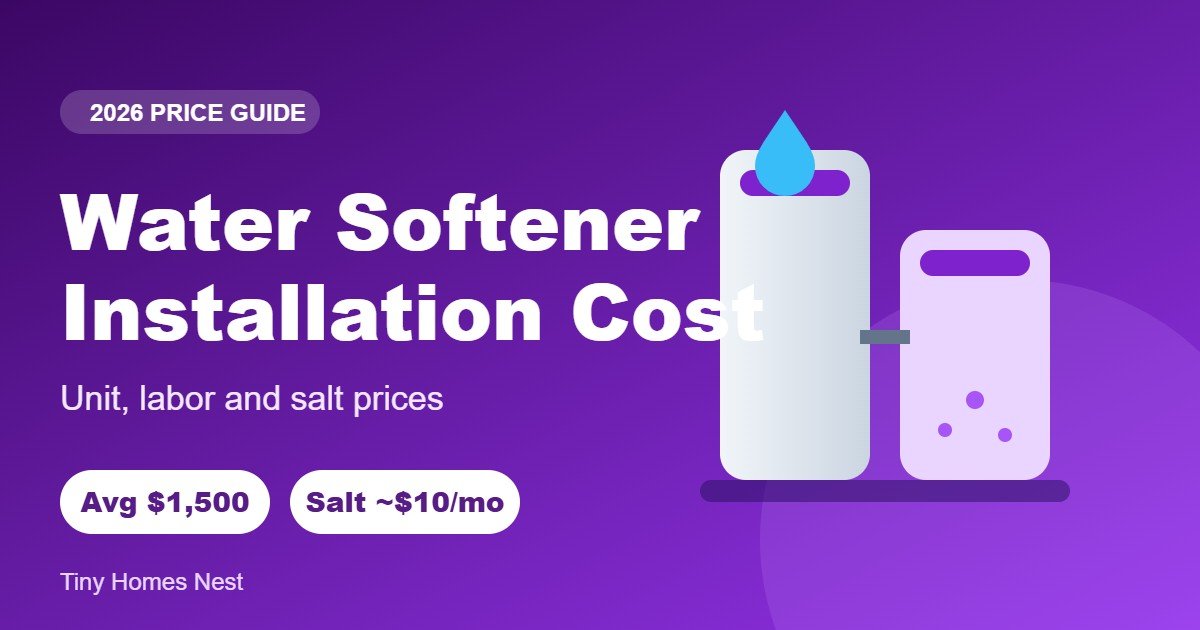
White crust on the faucet. Soap that will not lather. A showerhead that clogs every few months. These are the classic signs of hard water. A water softener fixes it but the price tag is confusing. The water softener installation cost ranges from a few hundred dollars for a simple unit to several thousand for a premium system.
This guide breaks the bill into parts you can check. We compare Angi and InchCalculator side by side. The two sources overlap on the average and differ on some details. We show both. Any number that is our own math is labeled as ours.
Water Softener Installation Cost at a Glance
Both sources give the same national average. The ranges differ a little.
| Source | National average | Range |
|---|---|---|
| Angi | About $1,500 | $200 to $6,000 |
| InchCalculator | $1,500 | $500 to $6,000 |
InchCalculator says a five-member home with a whole-house system pays around $1,500 fully installed. That is a useful anchor. If a quote is far above that ask what is included. If it is far below ask what is missing.
The low end of the range usually means a small or magnetic unit. The high end means dual tanks or reverse osmosis. Most homes with a standard salt-based system land in the middle.
Cost by Type of Water Softener
The type you pick is the biggest price lever. Here is how the two sources list each one.
| Type | Angi (installed) | InchCalculator (equipment) |
|---|---|---|
| Single tank salt-based (ion exchange) | $500 to $1,700 | $400 to $1,200 for one or two tanks |
| Dual tank | $1,000 to $5,000 | $1,000 to $2,200 and up to $5,000 |
| Magnetic | $200 to $600 | $250 to $600 |
| Salt-free | $800 to $4,000 | Not listed |
| Reverse osmosis (whole home) | $4,000 to $11,000 | $4,000 to $11,000 |
| Reverse osmosis (point of use) | $1,500 to $1,800 | Not listed |
Angi also gives a wider range of $500 to $3,000 for ion exchange in another place. We show the table value. The two columns are not a perfect match because Angi lists installed prices and InchCalculator lists equipment. Read the columns as a guide and not an exact comparison.
A salt-based system uses an ion exchange resin to remove hardness minerals. A dual tank system keeps one tank working while the other recharges. That suits large homes. A magnetic unit is cheap but is not the same kind of product. A reverse osmosis system is a different job. It filters drinking water more than it softens the whole house.
Our own note: salt-free and magnetic products are often described as conditioners. They change how scale forms. They do not pull the hardness minerals out of the water in the same way a salt-based softener does. Check what any product claims to do before you pay for it.
Cost by Capacity
Capacity is measured in grains. A larger home or harder water needs a bigger unit. Angi lists these unit prices for materials only.
| Capacity (grains) | Unit price |
|---|---|
| 24,000 | $300 to $500 |
| 32,000 | $400 to $1,000 |
| 48,000 | $600 to $1,200 |
| 64,000 | $800 to $1,500 |
| 80,000 | $1,500 to $1,800 |
| 96,000 | $1,700 to $2,500 |
InchCalculator says whole-house salt systems start at 24,000 grains and larger systems cost more. It gives no price for each tier. Your installer should size the unit from your water test and your household size. Buying too small means the unit recharges too often. Buying too large means paying for capacity you will not use.
Installation and Labor Costs
Labor is where quotes diverge the most. Angi lists these figures:
- Installation labor: $150 to $1,000 depending on the unit and the location
- Basic systems: about $150 in labor
- Installation time: about 2 to 4 hours on average
InchCalculator says professional installation costs $1,000 or more depending on plumbing changes. It also says DIY could save around $1,000. The two sources do not agree on labor. Angi's range starts much lower. The gap likely comes from how much plumbing work each source assumes. We cannot confirm that. So collect at least two quotes and ask each installer to list the labor line.
Extras That Raise the Price
Some homes need more than a simple hookup. Angi lists these:
| Extra | Cost |
|---|---|
| New piping | $0.50 to $8 per linear foot |
| New wiring | $2 to $4 per square foot |
| Support framing | About $3,800 on average |
InchCalculator adds a permit at $20 to $100 where one is required. Rules vary by city. The softener also needs a drain line for the backwash water and an outlet nearby. If your plumbing is far from a drain or an outlet expect more labor. That last point is our own note and not a figure from the sources.
Ongoing Costs: Salt and Repairs
The purchase is only the start. A salt-based system needs salt or potassium to recharge.
| Item | Angi | InchCalculator |
|---|---|---|
| Salt (per 40 lb bag) | $5 to $10 | $5 to $10 |
| Potassium chloride (per 40 lb bag) | $50 to $70 | $25 to $50 |
| Monthly salt cost | Not listed | About $10 |
| Monthly potassium cost | Not listed | About $50 |
| Repairs | $150 to $900 on average and up to $2,000 | Not listed |
| Rental | $25 to $50 per month | Not listed |
Here is our own math. Salt at about $10 a month is $120 a year. Potassium at about $50 a month is $600 a year. A rental at $25 to $50 a month is $300 to $600 a year. Over 10 years the salt route costs far less than the potassium route. Potassium is an option for people who want to avoid sodium. It is a real trade off.
Neither source gives a single yearly maintenance total. So treat these as inputs to your own estimate.
How Long Does a Water Softener Last?
Angi says a softener can last up to 25 years with proper maintenance. A single tank electric unit may last about 12 years. Repairs are typically needed every 10 to 20 years. InchCalculator does not give a lifespan.
That wide range is honest. A well kept unit in moderate hard water lasts a long time. A neglected unit in very hard water wears out sooner. Clean the brine tank when the manual says to. Use the salt type the maker recommends.
Do You Actually Need a Water Softener?
Test first. Do not buy a system based on a salesperson's tap check. Angi lists the signs of hard water:
- Rising utility bills
- Dry skin and nails
- Staining on fixtures
- A hardness test result that is high
Angi gives these test ranges as calcium carbonate in mg per liter. A result of 0 to 60 is soft to slightly hard. A result of 61 to 120 is moderately hard. A result of 121 to 180 is hard. A result over 180 is very hard.
InchCalculator says a DIY test kit costs $20 to $50 and a professional test costs $50 to $100. A professional test is a good use of money before a $1,500 purchase.
If your shower runs weak because of scale see our guide on how to fix a leaking shower head for the basic checks. Scale spots on appliances are also a hard water sign. Our post on how to clean stainless steel appliances helps with the surface marks.
Is a Water Softener Worth the Money?
The sources point to a few benefits. Angi says hard water can shorten water heater life and raise heating costs. Softened water reduces mineral buildup on surfaces and in pipes and may extend plumbing life. It can also reduce spending on soap and laundry and it is gentler on skin and hair.
InchCalculator says a softener could potentially save you thousands on plumbing repairs but gives no figure. We would not count on that number. Neither source quantifies the savings. So decide based on what you can see. If scale is wrecking fixtures and your water heater is struggling a softener is worth pricing.
A softener also protects your water heater. See our water heater replacement cost guide to see what a new one costs. A replacement water heater is a big bill that a softener may help you delay. That is our reading of the Angi point about heater life.
DIY or Professional Installation?
InchCalculator says DIY installation could save around $1,000. Angi says a pro costs more up front but gives faster setup and correct sizing and reliable performance. If you have no experience Angi recommends a plumber.
A softener ties into the main water line and a drain. A mistake can flood a basement. Our view is that a handy homeowner with plumbing experience can do it. Everyone else should hire a pro. For other plumbing jobs that may come with the install read our plumbing repair cost guide.
Sample Budgets Using These Ranges
These are not quotes. They combine published ranges and are our own math.
Basic single tank salt-based unit. Angi shows $500 to $1,700 installed. The InchCalculator average for a five-member home is about $1,500.
Equipment plus pro install. InchCalculator equipment runs $400 to $1,200 and professional installation is $1,000 or more. That puts the total at $1,400 or more.
DIY install of a single tank. Equipment of $400 to $1,200 only. Add a $20 to $100 permit if your city asks for one. The total is $420 to $1,300.
Magnetic unit. $200 to $600 installed by Angi. Check that it does what you need.
Whole-home reverse osmosis. $4,000 to $11,000 by both sources.
How to Lower Your Water Softener Installation Cost
- Test the water first. A $50 to $100 test tells you if you need a system and what size.
- Right size the unit. Too much capacity wastes money.
- Get two or three quotes. Ask each to separate equipment and labor and extras.
- Keep it close to the main line. Short pipe runs cut labor.
- Use salt and not potassium. It costs far less to run unless you need to avoid sodium.
- Do a simple install yourself. Only if you have plumbing skills.
If you are remodeling at the same time our home renovation cost guide shows how to fit this into your total budget.
Quick Decision Guide
- Hard water and a standard home: single tank salt-based system.
- Large family or very hard water: dual tank.
- Low budget: test first. A magnetic unit is cheap but check its claims.
- Drinking water concerns: consider reverse osmosis at the tap.
- Not sure: pay for a professional water test.
Frequently Asked Questions
How much does it cost to install a water softener?
Angi and InchCalculator both put the national average at about $1,500. Angi's range is $200 to $6,000. InchCalculator's range is $500 to $6,000. The type and capacity and plumbing work decide the price.
How much is labor to install a water softener?
Angi says $150 to $1,000 and about 2 to 4 hours. InchCalculator says professional installation costs $1,000 or more depending on plumbing changes. Get written quotes.
How much does a water softener cost per month to run?
InchCalculator puts salt at about $10 a month and potassium at about $50 a month. Rental runs $25 to $50 a month according to Angi.
How long does a water softener last?
Angi says up to 25 years with proper maintenance. A single tank electric unit may last about 12 years. Repairs are typically needed every 10 to 20 years.
Is a salt-free water softener cheaper?
Not always. Angi lists salt-free systems at $800 to $4,000 installed. Magnetic units are cheaper at $200 to $600. Check what each product actually does.
Can I install a water softener myself?
You can if you have plumbing experience. InchCalculator says DIY could save around $1,000. Angi recommends a plumber if you have no experience.
Do I need a permit for a water softener?
Some cities require one. InchCalculator puts a permit at $20 to $100 where required. Ask your local building office.
How do I know if I have hard water?
Look for staining and dry skin and high utility bills. Angi lists a test scale where over 180 mg per liter is very hard. A DIY kit costs $20 to $50 and a professional test costs $50 to $100.
Final Thoughts on Water Softener Installation Cost
The water softener installation cost averages about $1,500 across both sources. A simple salt-based unit sits below that and a dual tank or reverse osmosis system sits above it. Capacity and plumbing work decide most of the bill.
Test your water first and size the unit to your home. Compare itemized quotes and plan for salt each month. With those steps you pay for the softening you need and nothing more.





One Comment