Smart Homes: 7 Amazing Benefits, Costs & How They Work
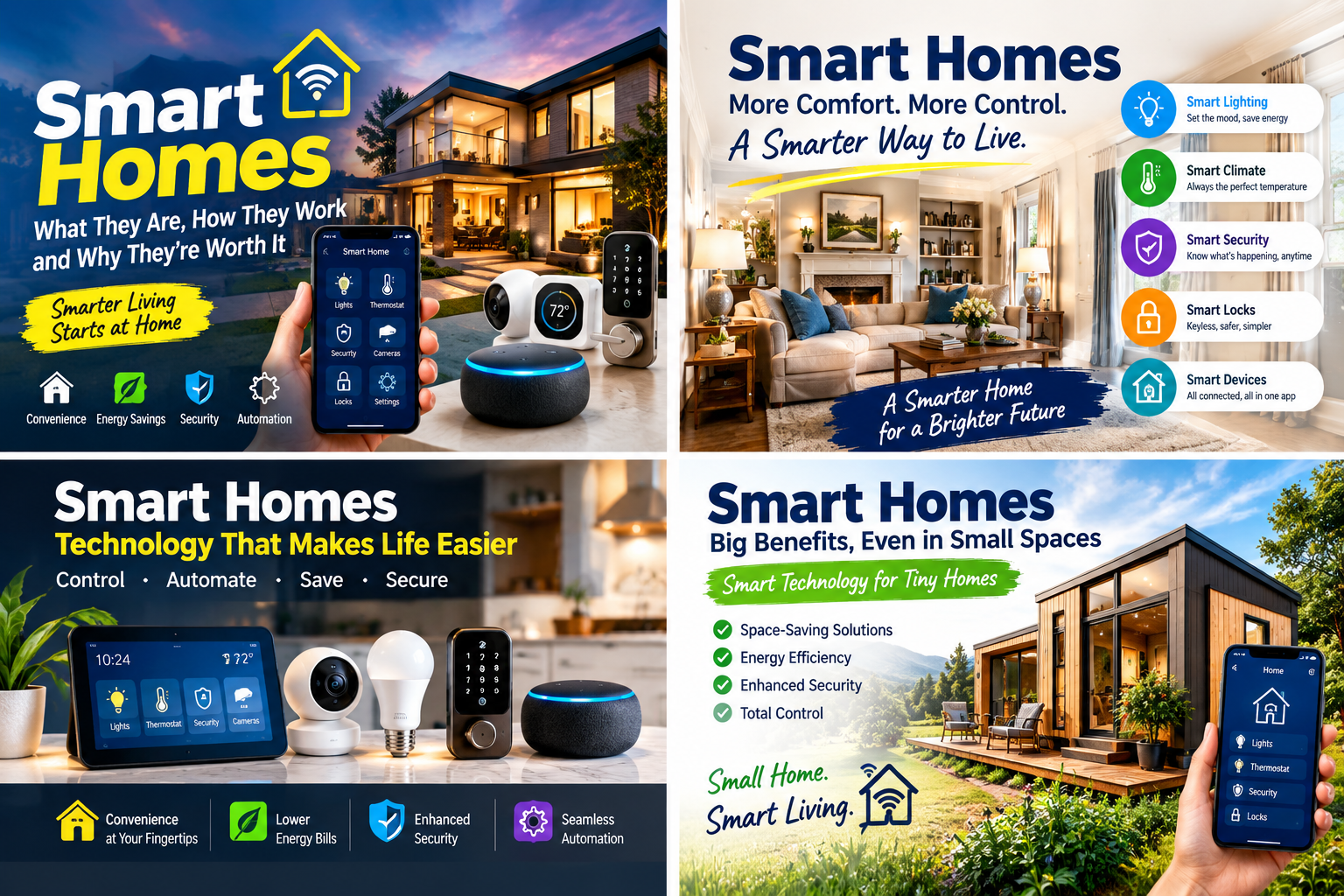
Smart Homes: What They Are, How They Work and Why They’re Worth It
What is a smart home? It’s a house where internet-connected devices, lighting, locks, thermostats, cameras and more, can be controlled remotely, automated on a schedule or triggered by each other, instead of operated one switch or dial at a time. The idea has moved from a novelty for tech enthusiasts to a mainstream feature buyers now expect. The technology behind it has also gotten dramatically easier to set up along the way.
This guide covers what smart homes actually are, how the technology works and the real benefits and drawbacks. It also looks at where the category is headed, including what it looks like in a much smaller footprint than the average suburban house.
Quick answer: A smart home uses connected devices, lighting, security, climate control and more, that can be controlled through an app, voice assistant or automated routine. The appeal comes down to convenience, energy savings and security, though setup complexity and privacy concerns are real tradeoffs worth understanding before you buy your first device.
What Is a Smart Home
At its core, a smart home connects everyday household devices to the internet or to each other so they can be controlled remotely and respond automatically to triggers like time of day, occupancy or a command from a voice assistant.
The simplest version is a single smart plug or smart bulb controlled from a phone app. The most advanced version is a whole-home system where lighting, climate, security, entertainment and access control all talk to each other through one interface, often set up by a professional integrator. Most households land somewhere in between, adding devices gradually as a specific need comes up rather than automating everything at once.
How Smart Home Technology Works
Smart home devices rely on a small set of underlying technologies working together, even though the end result feels simple from the user’s side.
Connectivity. Most devices connect over home WiFi, though some systems use dedicated low-power protocols like Zigbee or Z-Wave instead, specifically because they use less battery and create a more reliable mesh network across a larger home than WiFi alone usually manages.
A central hub or app. Many systems route commands through a central hub, a smart speaker or a dedicated app that acts as the control point for every connected device. This hub is also what makes cross-device automation possible, letting a motion sensor trigger a light or a door sensor trigger a camera recording.
Automation and routines. Rather than controlling each device manually every time, most smart home platforms let you set rules: lights that turn on at sunset, a thermostat that drops at night, a lock that engages automatically when everyone leaves. This rule-based automation is where most of the practical daily value actually comes from, more than the novelty of voice control.
Voice assistants. Alexa, Google Assistant and similar platforms sit on top of this system as a convenient control layer rather than the foundation itself. A smart home works perfectly well without voice control, though most people find it the fastest way to interact with the system once it’s set up.
Common Smart Home Devices and Systems
Most smart homes are built up from a handful of recognizable categories rather than one single product.
Lighting. Smart bulbs and switches allow dimming, scheduling and remote control. They’re usually the cheapest and easiest entry point into the category.
Climate. A smart thermostat learns a household’s schedule and adjusts heating and cooling automatically, often the single device with the clearest energy savings payoff.
Security. Cameras, video doorbells, door and window sensors and motion detectors form the backbone of most smart security setups, frequently tied together through a single monitoring app.
Locks. A smart lock allows keyless entry, temporary access codes for guests and remote locking confirmation, which is especially useful for anyone who has ever worried about whether they locked up on the way out.
Entertainment and voice assistants. Smart speakers and connected entertainment systems often double as the household’s main control hub for every other category listed here.
Window treatments. Motorized blinds and shades round out most full systems, adding automated light and privacy control without manual adjustment throughout the day.
Pricing and installation details for each of these categories vary considerably, covered in full further down this guide.
A Brief History of Smart Homes
Home automation is older than most people assume. The first consumer system, X10, launched in the 1970s and let devices communicate over a home’s existing electrical wiring, though setup was technical and the devices themselves were limited and expensive.
Smartphones changed everything in the following decades by giving every device a remote control people already carried. The arrival of affordable WiFi-connected devices in the 2010s, combined with voice assistants like Amazon Echo in 2014, moved smart home technology from a hobbyist project into something a typical homeowner could set up in an afternoon. Today’s systems increasingly use AI to anticipate needs rather than simply responding to manual rules, which is the next major shift already underway.
Benefits of Smart Homes
The appeal of a smart home comes down to a handful of concrete advantages rather than novelty alone.
Convenience. Controlling lighting, climate and locks from one app or through a voice command removes a lot of small daily friction. This matters especially for anyone managing a household with a lot of moving parts.
Energy savings. Smart thermostats that learn a household’s schedule, combined with lighting that turns off automatically in empty rooms, can meaningfully reduce utility costs over a year without requiring constant manual attention.
Security. Remote camera access, automatic locking and instant alerts when a door or window opens give homeowners real-time awareness they simply don’t get from a traditional lock and deadbolt.
Accessibility. Voice-controlled lighting, locks and thermostats can make a home significantly easier to live in for anyone with mobility limitations, removing the need to physically reach a switch or panel.
Home value. Buyers increasingly expect at least basic smart features. A well-integrated system can be a genuine selling point rather than just a personal convenience.
Smart Homes: Pros and Cons
Weighing the benefits against the real tradeoffs gives a more complete picture than the marketing usually does.
Pros
- Meaningful convenience once routines and automations are set up correctly
- Real potential for lower energy bills over time
- Stronger security awareness through remote monitoring and alerts
- Devices that scale gradually, starting small is genuinely realistic
- Growing buyer expectation that can support resale value
Cons
- Privacy and data security concerns, since connected devices collect usage data and are a potential target for hackers
- Dependence on home WiFi or internet service, a connectivity drop can disable core functions
- Fragmented ecosystems, since not every brand works smoothly with every other brand
- Upfront cost that can climb quickly for a full whole-home system
- A learning curve for anyone unfamiliar with app-based device management
The Role of AI in Smart Homes
Artificial intelligence is reshaping smart home technology faster than almost any other home improvement category right now.
Early smart home automation relied entirely on rules a person set manually: turn on this light at this time, lock this door at that time. AI-driven systems increasingly learn patterns instead. A thermostat adjusts based on actual occupancy history rather than a fixed schedule. A security camera flags genuinely unusual activity instead of alerting on every motion event. Voice assistants have also gotten noticeably better at understanding natural requests rather than requiring a specific phrase, which has lowered the learning curve for new users considerably.
Smart Homes of the Future
The next phase of smart home technology leans heavily on better interoperability and more predictive automation rather than entirely new device categories.
Industry efforts around a unified connectivity standard are aiming to let devices from different brands work together more reliably, addressing one of the category’s longest-standing frustrations. Predictive automation, systems that anticipate a need before a person acts, is also moving from a premium feature into a standard one. Expect smart homes five years from now to require noticeably less manual setup and fewer dedicated apps than the current generation does, even as the number of connected devices in an average home keeps climbing.
Smart Technology in Tiny Homes
Smart home technology solves a slightly different problem in a tiny home than it does in a standard house. It’s worth its own mention given how differently the math works out.
Square footage is tight, so automation that saves physical steps, a single app controlling lighting, climate and locks instead of several separate panels, has an outsized impact relative to the home’s size. Energy efficiency also matters more in a tiny home’s tighter systems, where a smart thermostat or smart water heater controller can meaningfully affect a smaller, more sensitive utility setup. Security features like a smart lock and compact camera system matter just as much in a tiny home as a large one, often more, since tiny homes are frequently parked in locations without the built-in security of a traditional neighborhood.
For anyone planning a higher-end build, this breakdown of what luxury tiny homes actually include covers where smart technology tends to show up as a standard feature rather than an add-on. For anyone specifically comparing layouts that need to fit automation wiring and panels into a smaller footprint, this guide to 2 bedroom tiny homes is a useful next read.
How Much Do Smart Homes Cost
Cost varies enormously depending on scope, from a single $20 smart plug to a fully integrated whole-home system costing tens of thousands of dollars.
Rather than duplicate that breakdown here, our smart home cost guide covers real 2026 pricing by device type, system tier and installation method, including the DIY versus professional installation tradeoff in detail. If you’re planning to install devices yourself as part of a broader project, this list of DIY home improvement projects worth doing yourself is a useful companion read for deciding what to tackle without a contractor.
For privacy and security considerations when using connected devices, the Federal Trade Commission’s guidance on internet-connected devices is also a useful external resource.
Frequently Asked Questions
What is a smart home?
A smart home is a house with internet-connected devices, such as lighting, locks, thermostats and cameras, that can be controlled remotely, automated or triggered by each other instead of operated manually one at a time.
Are smart homes worth it?
For most households, yes, especially starting with a few targeted devices like a smart thermostat or video doorbell rather than a full whole-home system. The convenience and energy savings tend to justify the cost quickly, while a full professional installation is worth it mainly for larger homes or serious security needs.
Do smart homes increase home value?
Smart features are increasingly expected by buyers and can support resale value, though they rarely add value on their own the way a kitchen remodel might. A well-integrated, well-maintained system is viewed as a convenience upgrade rather than a major value driver.
Can I make my home smart without a big renovation?
Yes. Most smart home devices, plugs, bulbs, locks, thermostats and cameras, are designed to install without any wiring changes and connect directly to existing home WiFi, making this one of the more approachable home upgrades available.
Is a smart home safe from hacking?
No connected system is completely risk-free. Strong, unique passwords, keeping device firmware updated and using a separate WiFi network for smart devices meaningfully reduce the real-world risk most households actually face.
What’s the difference between a smart home and home automation?
The terms are often used interchangeably. Home automation technically refers to the rule-based triggers and schedules themselves, while a smart home describes the broader connected system those automations run on, devices, hub and app included.
What’s the best smart home device to start with?
A smart thermostat or a video doorbell are usually the best starting points, since both solve an everyday problem on their own without requiring any other device to be useful, unlike a hub-dependent system that needs several pieces in place before it does much.
Final Thoughts
Smart homes have moved from a niche hobby to a mainstream expectation. The technology keeps getting easier to adopt in small, deliberate steps. Starting with one or two devices that solve a real daily problem, rather than automating an entire house at once, remains the most reliable way to find out whether the category is worth expanding further in your own home.