Smart Home Cost Guide: Devices and Installation Pricing for 2026
By Emily Hartman, Founder & Lead Editor at Tiny Homes Nest. Tiny home owner since 2019.
Smart home technology cost can mean a $50 smart plug from a big box store or a $50,000 whole-house automation system installed by a certified integrator. Most homeowners land somewhere confused in between. This guide breaks down real 2026 smart home cost by device type, system tier and installation method, so you know what you are actually paying for before you add anything to a cart. The category has also grown fast enough that pricing varies more between a DIY approach and a professional integration than it does between most individual brands.
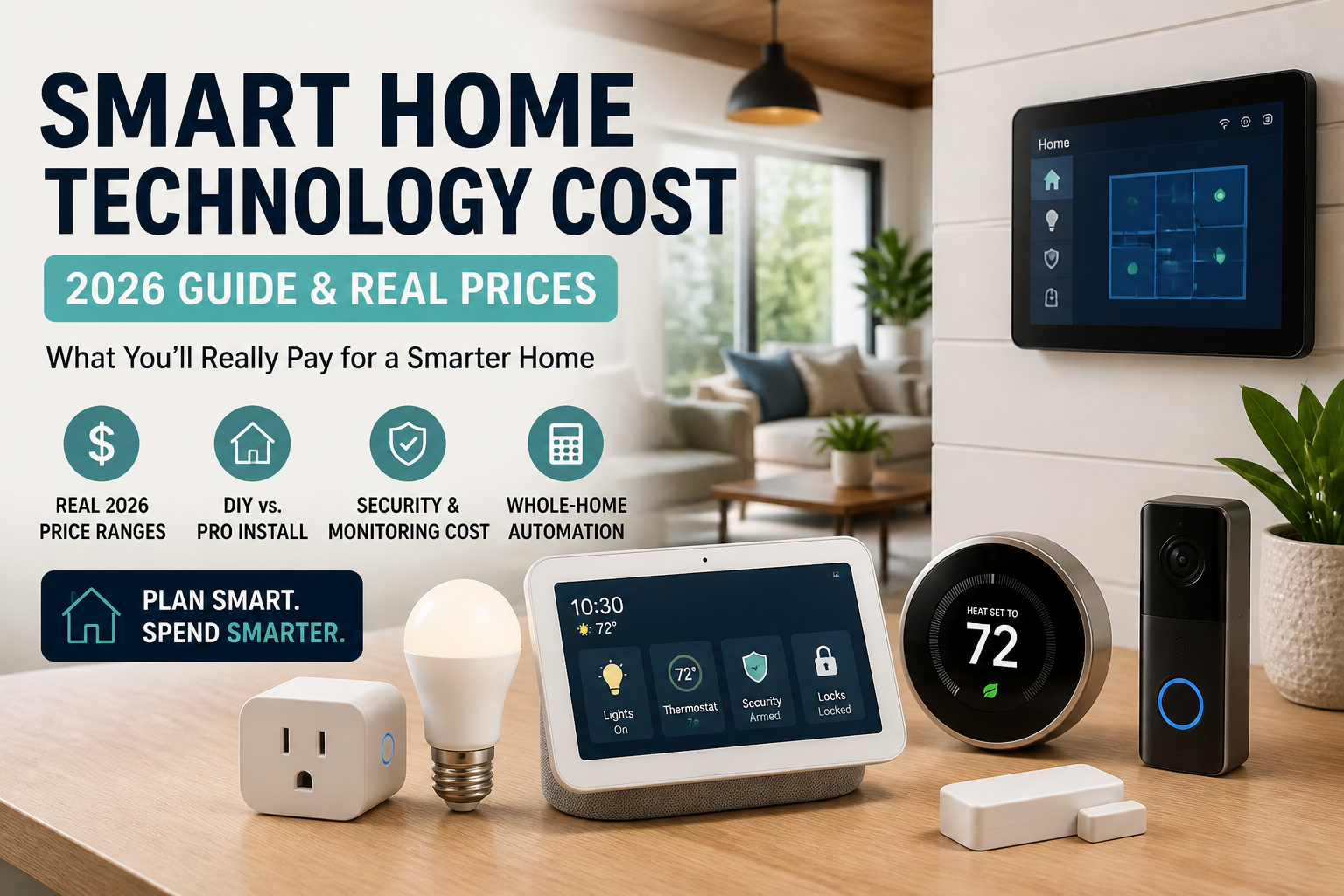
Quick answer: Smart home technology cost in 2026 typically runs $200 to $2,500 for a basic to mid-range device setup, with professional whole-home automation systems running $5,000 to $50,000 or more. Security-focused systems specifically average $600 to $1,141, with monthly monitoring adding $20 to $60 on top of equipment cost.
How Much Does Smart Home Technology Cost in 2026? Quick Answer
Smart home cost depends almost entirely on how many systems you are automating and whether you install everything yourself or hire a professional integrator.
A basic DIY setup, a handful of smart plugs, a video doorbell and a smart thermostat, typically costs $200 to $600 in equipment with no installation labor required. A mid-range system covering security, lighting and climate across a standard home generally runs $800 to $5,000 depending on device count and whether professional installation is included. A full professional whole-home automation system, integrating security, lighting, climate, entertainment and access control through a single interface, commonly costs $5,000 to $50,000, with luxury custom builds from high-end integrators exceeding $100,000. Monthly monitoring or subscription fees, where applicable, typically add $20 to $60 per month on top of any of these tiers. Knowing which tier your actual needs fall into before shopping prevents both overspending on unnecessary complexity and underbuying a system that cannot grow with your household.
Smart Home Cost by System Type
Every smart home category carries its own price range. Bundling several categories together rarely costs as much as adding up each one separately at full retail.
| System Type | Typical Cost | Notes |
| Individual smart devices | $15 to $500 each | Lighting, locks, thermostats, sensors |
| DIY security kit | $200 to $600 | 3 to 5 wireless components, self-install |
| Mid-range security system | $800 to $1,800 | 8 to 12 devices, better coverage |
| Professional-grade security | $2,000 to $5,000 | Hardwired, cellular backup, full coverage |
| Whole-home automation | $5,000 to $50,000+ | Professionally integrated, single-interface control |
A smart thermostat typically costs $130 to $500 installed. Smart lighting runs $15 to $90 per switch or bulb depending on features. A smart lock generally costs around $150 per device before installation. These individual costs add up quickly once you automate an entire home room by room, which is exactly why whole-home packages often work out cheaper per device than buying everything piecemeal over time. A smart smoke alarm typically runs $35 to $100. A glass break sensor adds another $100 to $200 per unit if perimeter monitoring is part of your plan.
DIY Smart Home vs. Professional Installation Cost
Choosing between installing smart home devices yourself and hiring a professional comes down to system complexity more than raw cost savings.
DIY installation works well for standalone devices, smart plugs, video doorbells, individual smart bulbs, that connect directly to home WiFi without any wiring changes. Professional installation becomes worthwhile once a project involves hardwiring, whole-home network configuration or integrating multiple systems to work together seamlessly. Professional installation typically adds $120 to $600 for a standard security system, climbing to $800 to $1,600 for a fully wired setup requiring wall access. Hiring a professional also typically includes system calibration and a walkthrough of how everything works together, value that a self-installed system usually has to figure out through trial and error instead. A homeowner comfortable with basic networking concepts can often handle a surprisingly complex DIY setup. Anyone unfamiliar with WiFi mesh networks or device pairing protocols tends to underestimate how much time a large DIY project actually takes, though.
Smart Home Security System Cost
Security is the smart home category homeowners research most. It also carries the widest real-world price spread of any single system type, ranging from a $45 standalone sensor to a fully integrated commercial-grade setup costing thousands.
A basic DIY security kit with three to five wireless components typically costs $200 to $600, including a base station, door and window sensors and a motion detector. A mid-range system with eight to twelve devices and upgraded sensors runs $800 to $1,800. Professional-grade equipment with hardwired control panels, cellular backup and professional cameras jumps to $2,000 to $5,000. High-end installations for larger homes or properties requiring commercial-grade components can reach $8,000 to $12,000. The national average cost for a home security system overall lands around $600 to $1,141 once equipment and typical installation are combined, though this figure varies enormously depending on home size and how many entry points need coverage. Homes with multiple entrances, large windows at ground level or detached structures like a garage or shed typically need more sensors than a compact floor plan, which pushes the total toward the higher end of these ranges regardless of which tier you start from.
Monthly Subscription and Monitoring Costs
Many smart home systems carry an ongoing monthly cost that the upfront equipment price does not reflect. This recurring fee deserves as much attention as the initial purchase.
Professional monitoring typically runs $20 to $60 per month, with premium plans from some providers reaching $80 to $99. Self-monitored systems, where you receive alerts directly rather than through a monitoring center, often carry little to no monthly fee, though you lose the automatic emergency dispatch a monitored system provides. Bundling video storage, advanced notifications and multi-user app access into one plan is common, so comparing what each provider’s monthly fee actually includes matters more than comparing the headline price alone. Before signing a monitoring contract, checking cancellation terms and any required contract length prevents a locked-in fee from outlasting the equipment it is protecting. Some providers waive equipment cost entirely in exchange for a multi-year monitoring commitment, which can look attractive upfront but often costs more over the contract term than buying equipment outright and choosing month-to-month monitoring instead.
Popular Smart Home Platforms Compared
A handful of established companies dominate the professionally installed side of this market, each with a genuinely different focus.
Vivint positions itself around integrated smart home security, offering flexible equipment packages from $200 for a basic setup to $2,500 or more for larger homes with full automation, generally paired with professional installation. ADT operates similarly, with security as the core offering and smart home features layered on top through add-on devices. Crestron sits at the premium end of the market entirely, specializing in whole-home automation for luxury builds rather than security specifically, with professional-only installation and pricing that reflects a fully custom integration rather than an off-the-shelf package. Choosing between these platforms comes down to whether security or whole-home automation is the actual priority, since a company built around one rarely matches a specialist in the other. Homeowners often assume these platforms compete directly on price, when in practice they are answering different questions about what a smart home is actually for in the first place.
How Much Does It Cost to Build a Fully Smart Home?
Automating an entire home from the ground up, rather than adding devices incrementally over time, follows a fairly predictable tiered structure.
A basic whole-home package covering essential lighting, a thermostat and core security typically costs $2,000 to $5,000. A mid-range build adding more extensive lighting control, multiple security zones and basic entertainment integration generally runs $5,000 to $15,000. A luxury, fully custom integration from a premium provider, whole-home audio, motorized shades, comprehensive access control, all managed through a single professionally programmed interface, commonly reaches $15,000 to $50,000, with the most elaborate builds exceeding $100,000. New construction and major renovations are the most cost-effective time to wire a home for whole-home automation, since running cable behind finished walls after the fact adds considerably more labor than doing it during an open-wall phase of a larger project. Retrofitting an existing home is still entirely possible, though it typically leans more heavily on wireless protocols to avoid the expense of opening walls that are already finished.
How to Use a Smart Home Cost Calculator
Online smart home cost calculators and estimators give a reasonable planning range, though they cannot account for your home’s specific wiring situation or which platform ecosystem you eventually choose.
Enter your home’s square footage and the systems you want to automate if the calculator asks for them. Treat the resulting number as a starting point rather than a firm quote, though. Before purchasing any connected device, the FTC’s guidance on securing internet-connected devices at home is worth reviewing, since smart home devices carry real privacy and security considerations alongside their cost. Get a written quote from any professional installer that separates equipment cost from labor and any ongoing subscription fees, since a bundled number makes it difficult to compare one provider’s offer against another’s on equal terms.
Frequently Asked Questions
How much does smart home technology cost on average?
Smart home technology typically costs $200 to $2,500 for a basic to mid-range setup, with professional whole-home automation running $5,000 to $50,000 or more depending on scope and integration level.
How much does a smart home security system cost?
Smart home security systems typically cost $600 to $1,141 on average once equipment and installation are combined, ranging from $200 for a basic DIY kit to $8,000 or more for a professional-grade system in a large home.
Is DIY smart home installation cheaper than hiring a professional?
Yes, generally, for standalone devices that connect directly to home WiFi. Professional installation becomes more cost-effective once a project involves hardwiring or integrating multiple systems, since it typically includes calibration a self-install would otherwise require through trial and error.
How much does it cost to fully automate a whole home?
A basic whole-home automation package costs $2,000 to $5,000. A mid-range build runs $5,000 to $15,000, while a luxury custom integration from a premium provider like Crestron commonly reaches $15,000 to $50,000 or more.
Do smart home systems require a monthly fee?
Many do, typically $20 to $60 for professional monitoring, though self-monitored systems often carry little to no ongoing cost. Always confirm what a monthly fee actually includes before signing a monitoring contract.
Is Vivint or ADT cheaper for a smart home security system?
Both operate in a similar price range, generally $200 to $2,500 for equipment depending on home size and device count. The better choice usually comes down to specific feature priorities rather than a meaningful price difference between the two.
Smart home cost comes down to matching system complexity to what you actually need automated, not chasing the cheapest device or the most impressive whole-home package. Start with the systems that matter most to your household, confirm installation and monitoring costs upfront and expand from there once you know which platform actually fits how you live. A phased approach, adding one system at a time rather than committing to a full build immediately, also gives you a real chance to test whether a platform fits your household before the budget grows to match a whole-home commitment.
Have a specific system or budget in mind? Drop it in the comments and our team will help you think through a realistic setup. Browse our full Home Improvement collection for more room-by-room and project-by-project cost guides as they go live.
Emily Hartman is the founder and lead editor at Tiny Homes Nest. After downsizing into a 340-square-foot home in 2019, she spent years working through zoning rules, financing options and real renovation costs firsthand. That experience is what she now turns into practical, no-fluff guides for buyers and downsizers.