Where Can You Buy Tiny Homes? Amazon, Builders and Marketplaces Compared
By Emily Hartman, Founder & Lead Editor at Tiny Homes Nest. Tiny home owner since 2019.
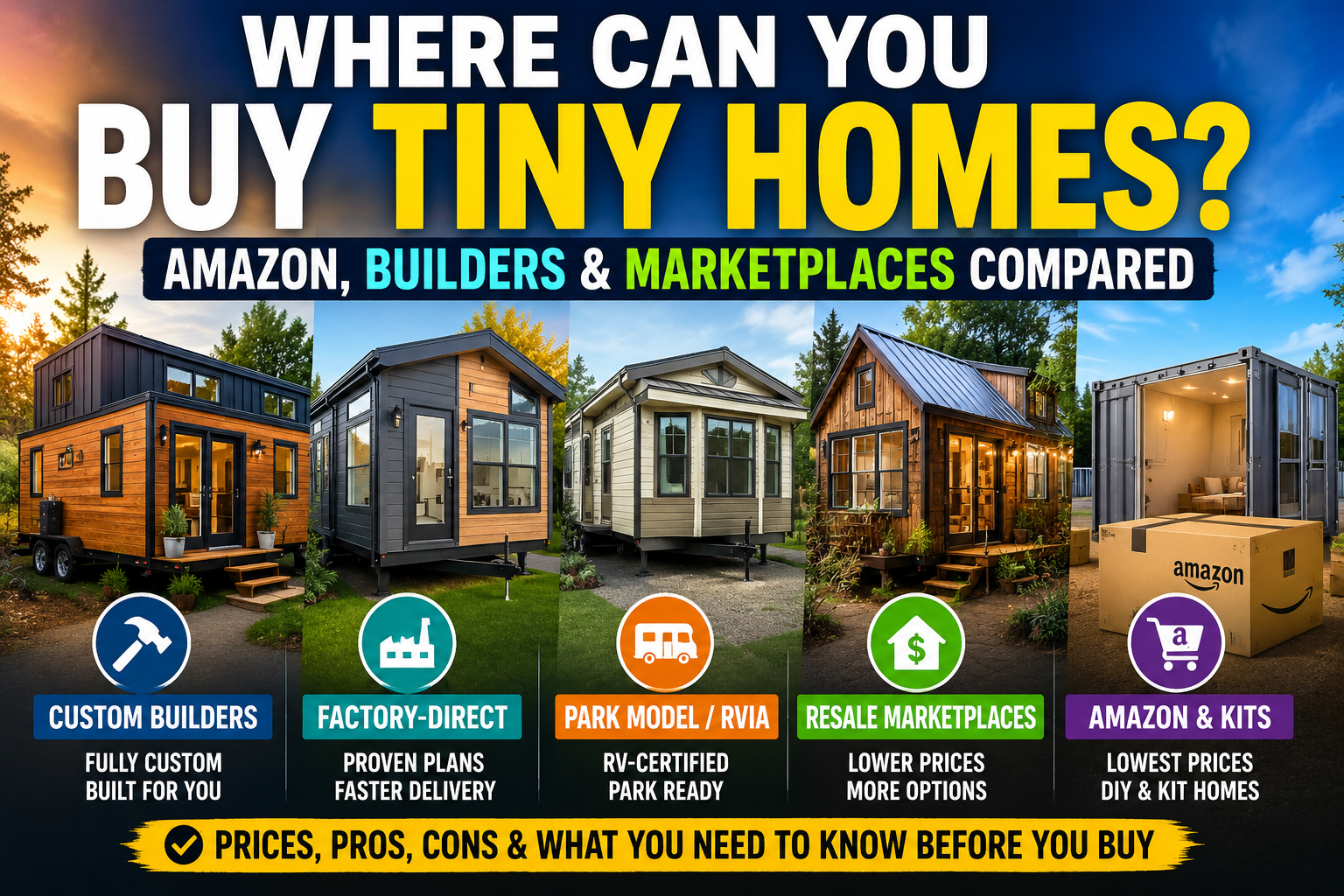
Most people picture two options when they think about buying a tiny home. You might drive to a builder’s lot or scroll listings online like a regular house hunt. Neither picture is complete. Tiny homes actually move through five very different sales channels, each with its own price, paperwork and risk level. Some channels hand you a finished, warrantied home. Others hand you a box of parts and a set of instructions. This guide breaks down exactly where to buy tiny homes, including the Amazon listings you have probably seen and wondered about.
Quick answer: You can buy a tiny home from a custom builder, a factory-direct manufacturer, a park model dealer, a resale marketplace or Amazon in a more limited sense. Builders and dealers offer the most legal certainty. Amazon and resale marketplaces offer the lowest prices. They also demand the most homework before you buy.
Where Can You Buy Tiny Homes? Quick Overview
Five channels cover almost every tiny home sale in the United States. Each one trades price against certainty in a different way. Understanding that trade-off before you start shopping saves you from an unpleasant surprise later.
| Channel | Typical Price | What You Are Really Buying | Best For |
|---|---|---|---|
| Custom builder | $45,000 to $150,000+ | Fully finished, professionally built home | Buyers who want customization and ongoing support |
| Factory-direct manufacturer | $40,000 to $100,000 | Standardized model, faster turnaround | Buyers who want a proven floor plan |
| Park model or RVIA dealer | $60,000 to $130,000 | RV-certified home ready for park placement | Buyers planning life in an RV-friendly community |
| Resale marketplace | $20,000 to $120,000 | Used or owner-built home, sold as-is | Budget buyers willing to inspect carefully |
| Amazon or online kit sellers | $2,000 to $36,000 | A shell or kit, usually self-assembly | Off-grid, backyard or non-residential use |
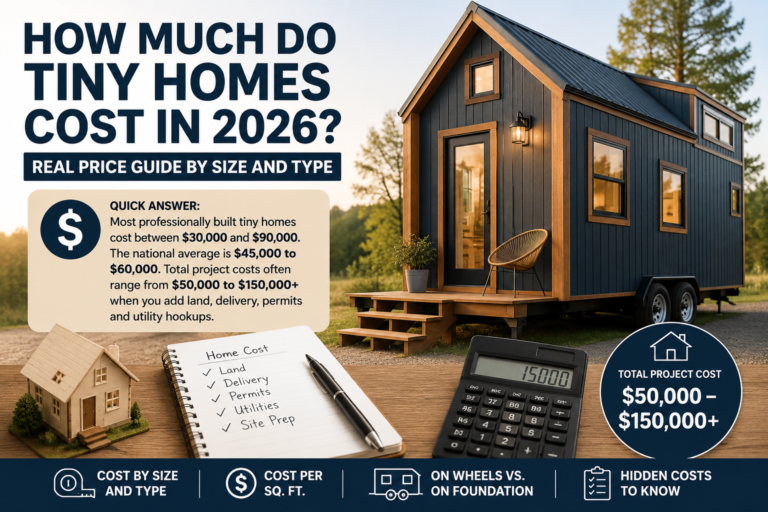
We cover full pricing by size and type in our tiny home cost guide, so use this table as a starting point rather than a final budget.
Buying From a Custom Tiny Home Builder
A custom builder gives you the most control over layout, materials and finish level. You typically start with a deposit, choose a base floor plan and then add upgrades from there.
Timelines usually run several months to a year, depending on the builder’s backlog and how much customization you request. Base prices look attractive on a builder’s website. Upgrades such as solid surface counters, upgraded appliances and off-grid systems add up fast, which is exactly why we built a full tiny home cost breakdown covering every line item buyers tend to underestimate.
Ask any builder for references from the last twelve months, not just their best-reviewed project ever. A builder’s current backlog and quality control matter more than a five-year-old showcase home. It also helps to ask how many homes the builder actually completed last year, since a long waiting list can push your delivery date well past the estimate on the contract.
Can You Actually Buy a Tiny Home on Amazon?
Yes. The listings are real. Prices for “tiny homes” on Amazon typically run from around $2,000 for a basic wood-frame shell to $36,000 or more for larger multi-room prefab kits.
Here is what those listings do not spell out clearly. Most Amazon tiny homes are flat-pack, steel-frame or wood-frame kits manufactured overseas and shipped by sea container. They arrive as a self-assembly kit, not a move-in ready home. They are generally not built to US residential building codes. That means most standard lenders will not finance them. In most jurisdictions, a kit like this also cannot legally serve as a primary residence.
That does not make them useless. For a remote off-grid cabin, a hunting shelter on private land or a backyard studio in a permissive county, an Amazon kit can be a reasonable buy. Just budget separately for delivery, which can run several thousand dollars on top of the listed price, plus your own labor or a contractor to assemble it, plus any local permit that still applies even to a “kit” structure. Read the listing’s fine print for what is actually included. Some kits ship without insulation, without windows installed or without any electrical wiring at all, which turns a $9,000 sticker price into a much larger project once you price out the missing pieces.
Buying a Used Tiny Home: Best Marketplaces
Resale is where tiny home prices get genuinely interesting. It is also where the risk shifts almost entirely onto the buyer.
Tiny House Listings has operated since 2010 and remains the largest dedicated marketplace, with thousands of active listings covering wheels-based homes, park models and land-inclusive properties. Facebook Marketplace and dedicated Facebook groups host a huge volume of private-party listings, though there is no formal escrow or verification process behind any of them. A handful of newer platforms combine a builder directory with resale listings in one place, which can be useful if you are still deciding between new and used.
Whichever platform you use, treat a used tiny home purchase like buying a used RV, not a used house. Inspect the roof, plumbing and electrical systems in person or through a qualified inspector. Ask for maintenance records and confirm the title is clear, especially for anything built on a trailer. A seller who cannot produce a clear title or any maintenance history at all is a reason to slow down, not a reason to negotiate harder on price.
Factory-Direct vs. Dealer Networks
Manufactured and park model tiny homes generally move through the same two channels as traditional manufactured housing: factory-direct sales and independent dealer lots.
Buying factory-direct usually means a lower price, since there is no dealer markup between you and the builder. Support after the sale can be slower, though, since you are working directly with a production facility rather than a local business. Dealer lots cost more but let you walk through a physical model, negotiate in person and lean on local support if something goes wrong after move-in. Dealers also tend to carry financing relationships already in place, which can simplify the paperwork if you need a loan.
Buying a Park Model or RVIA-Certified Tiny Home
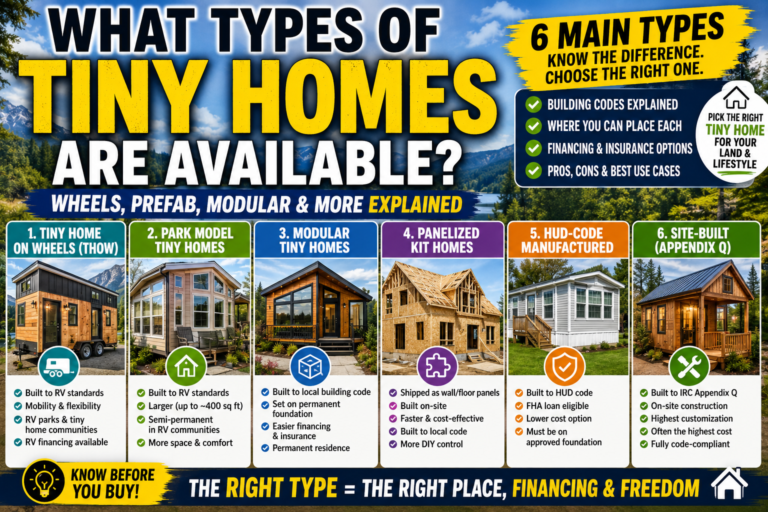
Park models sit in their own category. They are typically capped around 400 square feet, built to RV Industry Association standards rather than HUD residential code and classified legally as recreational vehicles rather than permanent dwellings.
That classification cuts both ways. RVIA certification opens the door to RV-style loans, which often carry better terms than a personal loan. It also means the home is generally meant for RV-friendly communities and seasonal or semi-permanent placement rather than a standard residential lot, so zoning research matters just as much here as it does for a home on wheels. Most park model dealers cluster near popular RV resort regions, so shopping in person may mean traveling outside your home state.
How Your Purchase Channel Affects Financing
The channel you buy through often decides whether financing is even possible, not just how much it costs. A HUD-compliant manufactured home on a permanent foundation can qualify for FHA-backed loan programs. An RVIA-certified park model or THOW can usually access RV or chattel loans instead. An Amazon kit or an uncertified used build typically qualifies for neither, which pushes buyers toward personal loans or cash. Our tiny home cost guide breaks down each financing path in more detail. The short version is simple, though. Confirm what a home is certified as before you fall in love with the price tag, since the certification decides your entire financing conversation before a lender ever runs your credit.
What to Verify Before You Buy
A handful of checks separate a smooth purchase from a stressful one, regardless of which channel you buy through.
- Confirm the compliance standard: HUD code for manufactured homes, RVIA certification for park models and THOWs or neither for kits and shells
- Get a full written spec sheet covering exactly what is included: appliances, plumbing, electrical, insulation and delivery
- Ask directly who handles warranty claims and what voids the warranty
- Check the builder or manufacturer’s track record over the last year, not just their oldest five-star review
- Confirm your local zoning department will actually allow the home type you are buying before you sign anything
HUD’s manufactured home consumer resources page is a genuinely useful, plain-language reference for warranty and standards questions if you are buying anything built to the HUD code.
Red Flags to Watch For When Buying a Tiny Home
Some warning signs show up across every channel, from Amazon kits to private resale listings.
- A price that seems impossibly low with no mention of “kit,” “shell” or “unassembled” anywhere in the listing
- A seller who will not put finish specifications or included items in writing
- No verifiable business address, phone number or independent reviews
- Pressure to pay the full amount before you see a real contract
- Listings built entirely around stock photography with no location-specific images
- Vague financing promises with no actual lender named
None of these automatically mean a scam. Together, though, they mean you should slow down and ask more questions before you commit.
Buying New vs. Used: Which Makes Sense for You
A new build from a builder or manufacturer gives you predictability. You know the finish level, you get a warranty and you are the first owner of every system inside it. The trade-off is cost and a longer wait, often several months from deposit to delivery.
A used tiny home can save tens of thousands of dollars and skip the wait entirely. You give up the warranty in most cases. You also take on the responsibility of verifying that everything inside actually works. For a first tiny home purchase, a thorough inspection is not optional. It is the entire difference between a good deal and an expensive mistake.
There is a middle path worth considering, too. Some builders sell showroom or display models at a discount once a newer version replaces them on the lot. You get a professionally built home with most of a warranty intact, often for meaningfully less than a fresh custom order. It is worth calling a handful of builders directly and simply asking whether a display model is available, since most do not advertise this option on their website.
Frequently Asked Questions
Can I really buy a tiny home on Amazon?
Yes, Amazon lists real tiny home kits, typically priced between $2,000 and $36,000. Most are self-assembly shells manufactured overseas, not finished, code-compliant homes ready for full-time living.
Is Tiny House Listings a legitimate marketplace?
Yes, it has operated since 2010 and is widely considered the largest dedicated marketplace for tiny homes. As with any resale marketplace, you still need to independently verify condition, title and the seller’s claims before you buy.
What is the difference between a park model and a tiny home on wheels?
Both are typically built to RV standards rather than residential building codes. Park models tend to be larger and are intended for more permanent placement in an RV-friendly community, while a THOW is generally built for more frequent mobility.
Should I buy directly from a manufacturer or through a dealer?
Buying factory-direct is usually cheaper, since there is no dealer markup added to the price. A dealer costs more but gives you a physical model to walk through and local support after the sale.
Can I buy a used tiny home and finance it?
Sometimes, though options are more limited than financing a new build. RVIA-certified used homes may qualify for RV-style loans, while unpermitted or uncertified used builds are much harder to finance through a traditional lender.
What should I always get in writing before buying a tiny home?
Get a complete spec sheet covering every included system, the delivery and setup terms, warranty coverage and exactly who is responsible if something fails after move-in. Verbal promises from a seller are not enforceable once the sale closes.
Where you buy a tiny home matters almost as much as which one you buy. A builder and a dealer both give you legal certainty and support. Amazon and resale marketplaces give you the lowest possible price, along with the most responsibility for verifying what you are actually getting. Match the channel to your comfort level with risk, not just to the number on the listing.
Still weighing new versus used or wheels versus a foundation? Our complete tiny homes guide walks through every major decision before you start shopping. Have a question about a specific listing you found? Drop it in the comments and our team will help you evaluate it.
Emily Hartman is the founder and lead editor at Tiny Homes Nest. After downsizing into a 340-square-foot home in 2019, she spent years working through zoning rules, financing options and real renovation costs firsthand. That experience is what she now turns into practical, no-fluff guides for buyers and downsizers.

3 Comments