What Is Laminate Flooring? Top 7 Benefits & Drawbacks to Know
What Is Laminate Flooring? A Complete Guide to How It’s Made and How It Works
What is laminate flooring? It’s a synthetic floor covering designed to look like real wood, stone, or tile without the cost and upkeep of the material it imitates. Instead of being made from a single solid material, laminate flooring consists of several thin layers pressed together under heat and pressure.
If you’re wondering what is laminate flooring made of, the short answer is a compressed wood-fiber core covered by a printed design layer, a protective wear layer, and a backing layer. This construction gives laminate its familiar wood-look appearance while keeping the price below many hardwood options.
This guide explains what is laminate flooring, how it is made, how it is installed, where it works best, how it compares with vinyl flooring, what it costs, and how to maintain it.
Quick Answer: What Is Laminate Flooring?
Laminate flooring is a multi-layer floating floor made from a compressed wood-fiber core, a decorative printed image layer, a protective wear layer, and a backing layer. The surface can imitate wood, stone, or tile.
Unlike solid hardwood, laminate does not contain a solid piece of natural wood on the surface. Its realistic appearance comes from a high-resolution printed design protected by a clear wear layer.
Laminate flooring generally costs less than hardwood, installs relatively quickly, and works well in dry everyday rooms. However, standard laminate is not fully waterproof because its wood-fiber core can swell when exposed to standing water.
What Is Laminate Flooring Made Of?
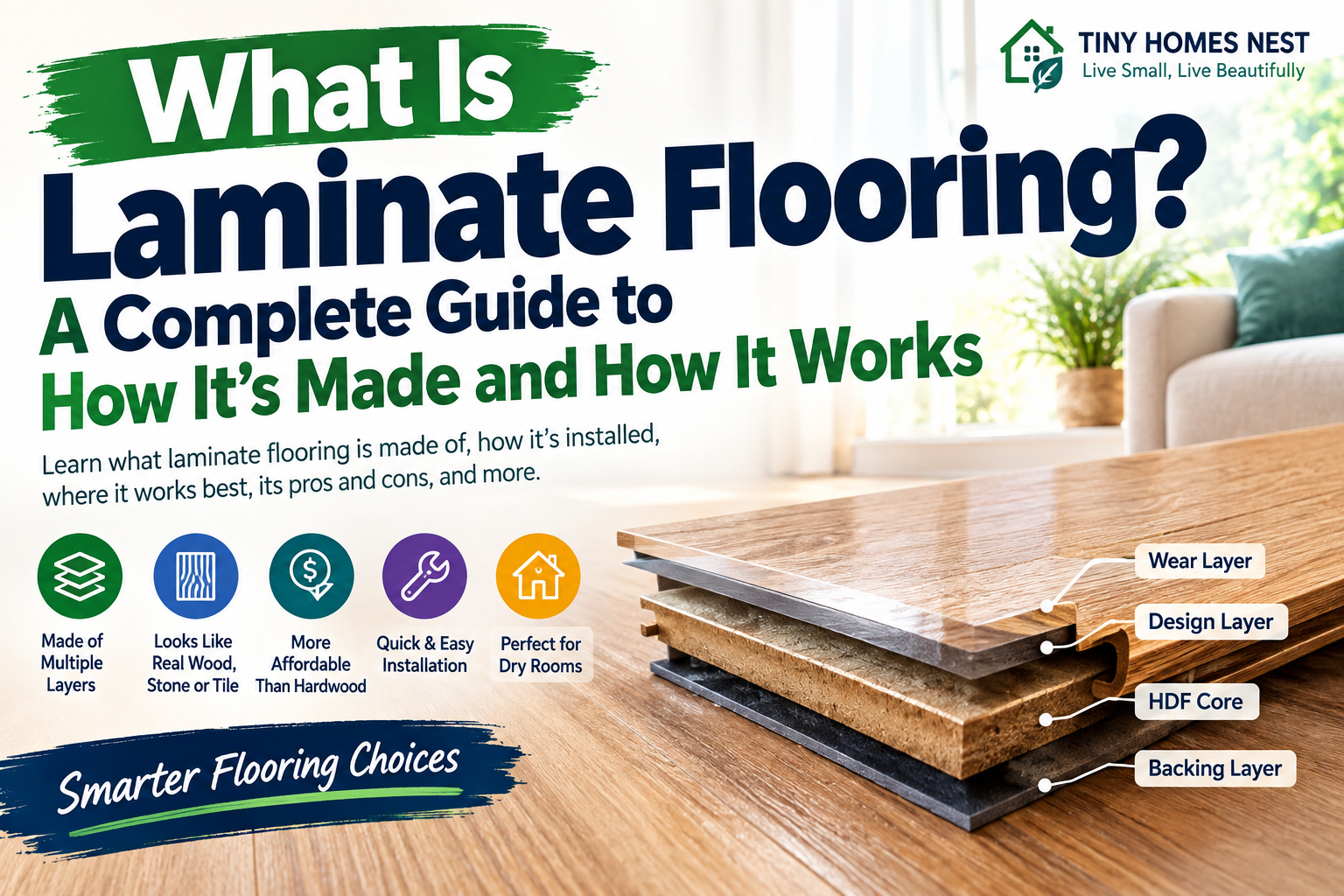
To understand what is laminate flooring made of, it helps to look at its four basic layers. Each layer has a specific purpose.
1. Wear Layer
The top layer is a clear, hard protective coating. It is commonly made using materials such as melamine resin or aluminum oxide. This layer helps protect the flooring from everyday scratches, stains, fading, and surface wear.
The wear layer is one reason laminate can handle regular household foot traffic while remaining less expensive than many hardwood products.
2. Design Layer
Under the protective wear layer is a high-resolution photographic design printed on paper or film. This is what gives laminate its wood-grain, stone, or tile appearance.
The design layer allows manufacturers to reproduce the appearance of different wood species, colors, grain patterns, and finishes without using solid wood throughout the plank.
3. Core Layer
The core is the structural part of laminate flooring. It is typically made from high-density fiberboard, commonly called HDF. HDF is a dense compressed wood-fiber material that provides strength and stability.
The core also supports the click-lock or tongue-and-groove edges used to connect individual planks during installation. Some lower-cost products may use medium-density fiberboard, or MDF, which is generally softer and less moisture-resistant.
4. Backing Layer
The backing layer is located at the bottom of the plank. It helps balance the plank, supports dimensional stability, and provides a basic moisture barrier between the core and the subfloor.
Because the core is wood-based rather than solid wood or plastic, laminate sits somewhere between traditional hardwood and vinyl in terms of construction and performance. That wood-fiber core is also the main reason standard laminate should not be treated as a fully waterproof flooring material.
What Is Laminate Flooring Made From During Manufacturing?
Understanding what is laminate flooring also means understanding how those layers become a finished plank. Laminate manufacturing is an industrial lamination process rather than traditional woodworking.
The core board, decorative design layer, and protective layers are stacked and fused under intense heat and pressure. The manufacturing process can use temperatures exceeding 350°F. The layers bond together to form a rigid flooring panel.
After the laminated sheets cool, they are cut into individual planks. The edges are then milled into interlocking profiles that allow the pieces to connect during installation.
This production method allows laminate flooring to be manufactured consistently and at a lower cost than the milling, sanding, staining, and finishing processes required for many solid hardwood floors.
Types of Laminate Flooring
Not every laminate product is identical. Thickness, surface construction, moisture resistance, appearance, and abrasion rating can vary considerably between product lines.
Wood-Look Laminate
Wood-look laminate is the most common style. It is designed to resemble species such as oak, walnut, maple, and other natural woods. Modern printing technology can reproduce grain patterns, knots, colors, and surface textures with considerable detail.
Stone-Look Laminate
Stone-look laminate uses a printed design that resembles natural stone. It can provide a similar visual style to tile or stone while maintaining the warmer feel and simpler installation associated with laminate flooring.
Tile-Look Laminate
Tile-look laminate uses printed patterns designed to resemble ceramic or porcelain tile. It can be useful when homeowners want a tile-inspired appearance without installing individual hard tile pieces.
Water-Resistant Laminate
Some newer laminate products are designed with denser cores and sealed edge systems that provide improved resistance to moisture. These products can reduce the risk from everyday spills, but product specifications still matter.
Water-resistant laminate should not automatically be treated as waterproof laminate. Always follow the manufacturer’s installation and moisture guidelines for the specific product.
AC Ratings
Laminate products can also be classified using abrasion class ratings from AC1 through AC5. The rating indicates how well the surface is designed to resist wear.
AC3 is commonly used for busy residential environments, while AC4 and AC5 are designed for higher levels of traffic. The appropriate rating depends on the room and expected use.
How Is Laminate Flooring Installed?
Most laminate flooring uses a floating-floor installation method. The planks connect to each other and sit over the prepared subfloor rather than being permanently glued or nailed down.
A thin foam underlayment is commonly installed beneath laminate flooring. Depending on the product and subfloor, the underlayment can provide cushioning and help reduce sound transmission.
Installers normally leave an expansion gap around the perimeter of the room. A gap of roughly one-quarter inch is commonly used, although the manufacturer’s installation instructions should always take priority.
The expansion space allows the flooring to respond to normal temperature and humidity changes. Without adequate expansion space, planks can buckle or press against walls.
Because many laminate systems use click-lock connections instead of adhesive or nails, laminate can be approachable for an experienced DIY installer. The subfloor still needs to be clean, dry, stable, and sufficiently flat for a successful installation.
What Is Laminate Flooring Compared With Vinyl?
One of the most common questions about what is laminate flooring involves how it compares with luxury vinyl plank, or LVP.
The biggest difference is the core material. Laminate normally uses a compressed wood-fiber core, while LVP uses a plastic-based construction.
Water Resistance
LVP is generally waterproof in many product lines because its plastic construction does not absorb water in the same way as a wood-fiber laminate core.
Standard laminate is not waterproof. Prolonged exposure to standing water can cause the wood-fiber core to swell, buckle, or become damaged.
Feel Underfoot
Laminate can feel relatively firm underfoot because of its rigid HDF core. Its appearance and feel can also be closer to traditional wood flooring than some vinyl products.
LVP generally has a little more flexibility and can feel warmer or softer underfoot depending on the product and installation.
Cost
Laminate and vinyl flooring can occupy similar general price ranges, although actual pricing varies according to product quality, thickness, installation requirements, brand, and location.
Best Rooms
Laminate works particularly well in dry rooms such as living rooms, bedrooms, home offices, hallways, and dining rooms.
LVP is often a better fit for areas where moisture exposure is a major concern, including bathrooms, laundry rooms, mudrooms, and moisture-prone basements.
Neither material is automatically the right choice for every room. The best option depends on the room’s moisture exposure, traffic, appearance preferences, and installation requirements.
Where Does Laminate Flooring Work Best?
Laminate performs well in consistently dry areas of a home. Common applications include living rooms, bedrooms, home offices, hallways, and dining rooms.
It can handle moderate household traffic and provides a wide range of decorative choices. Higher-quality products can also provide better resistance to everyday wear and fading.
Bathrooms, laundry rooms, mudrooms, and moisture-prone basements are generally less suitable for standard laminate because of the wood-fiber core.
Kitchens are more of a gray area. Small spills that are cleaned quickly may not cause problems, but kitchens with frequent standing water around sinks or dishwashers can create a greater moisture risk.
Laminate Flooring Pros and Cons
Now that you know what is laminate flooring and how it is constructed, the main advantages and disadvantages are easier to understand.
Pros
- Costs less than many solid hardwood flooring options.
- Can closely reproduce the appearance of natural wood.
- Offers wood, stone, and tile-look designs.
- Installs relatively quickly using a floating-floor system.
- Many products are suitable for confident DIY installers.
- The protective wear layer helps resist everyday scratches and stains.
- Available in multiple thicknesses, colors, textures, and durability levels.
Cons
- Standard laminate is not fully waterproof.
- Standing water can damage the wood-fiber core.
- Laminate cannot be sanded and refinished like solid hardwood.
- Some products can sound hollow without suitable underlayment.
- Lower-quality products may look less realistic up close.
- Moisture exposure can shorten the useful life of the flooring.
How Much Does Laminate Flooring Cost?
Laminate installation typically runs about $3 to $8 per square foot installed, with some premium products reaching approximately $13 per square foot installed. Material alone commonly falls around $1 to $5 per square foot, with labor accounting for the remainder.
The final price depends on the product, room size, subfloor condition, installation complexity, removal of existing flooring, trim work, and local labor rates.
For a broader comparison of flooring installation prices and material costs, see our flooring installation cost guide.
Does Laminate Flooring Increase Home Value?
Laminate is generally considered a practical and budget-conscious flooring choice rather than a premium upgrade. Its effect on resale value depends heavily on the condition, appearance, location, and expectations of the local housing market.
A clean, well-installed laminate floor can present much better than a damaged or visibly outdated floor. However, laminate generally does not carry the same premium perception as well-maintained solid hardwood.
For homeowners planning to sell, repairing visibly damaged flooring and choosing a style that fits the home can be more important than simply selecting a particular flooring category.
How to Clean and Maintain Laminate Flooring
Laminate flooring is relatively easy to maintain when moisture is controlled.
- Sweep or vacuum regularly to remove dirt and grit.
- Clean spills promptly rather than allowing water to sit.
- Use a damp rather than soaking-wet mop.
- Choose a cleaning product intended for laminate flooring.
- Avoid excessive water during cleaning.
- Avoid steam mops unless the flooring manufacturer specifically approves them.
- Use felt pads beneath furniture legs to reduce scratching.
- Keep abrasive dirt and debris away from high-traffic areas.
What Is Laminate Flooring’s Typical Lifespan?
A well-installed and properly maintained laminate floor can typically last around 15 to 25 years. Actual lifespan varies according to product quality, traffic, moisture exposure, subfloor preparation, maintenance, and installation quality.
Water damage, poor installation, heavy traffic, or inadequate subfloor preparation can shorten the useful life of laminate flooring.
What Is the Best Laminate Flooring?
The best laminate flooring for a particular room depends on traffic, moisture exposure, appearance, thickness, and product construction.
For busy households, look for an appropriate AC rating and a durable wear layer. Thicker products, such as 8mm or thicker options, can provide a more substantial feel, although thickness alone does not determine overall quality.
If moisture is a concern, consider a product specifically designed and rated for improved water resistance rather than assuming every laminate product performs the same way.
Can Laminate Flooring Be Installed Over an Existing Floor?
In many cases, laminate can be installed over an existing flooring surface if the existing surface is stable, sufficiently flat, clean, and suitable for the manufacturer’s installation requirements.
A suitable underlayment may be required depending on the product and existing floor. Always follow the manufacturer’s instructions before installation.
Is Laminate Flooring the Same as Laminate Wood Flooring?
Yes. The terms laminate wood flooring and wood laminate flooring are commonly used to describe laminate flooring designed to reproduce the appearance of natural wood.
Laminate can look like oak, walnut, maple, and many other wood species, but the flooring itself does not contain a solid hardwood surface.
Is Laminate Flooring Waterproof?
No. Standard laminate flooring is not fully waterproof. Its wood-fiber core can absorb moisture and swell if water remains on or around the flooring for an extended period.
Some newer products are specifically engineered to provide greater water resistance. However, homeowners should check the exact manufacturer’s specifications instead of assuming that all laminate flooring has the same moisture performance.
For additional information about formaldehyde and composite wood products, see the EPA questions and answers regarding laminate flooring and the EPA formaldehyde emission standards for composite wood products.
How Is Laminate Flooring Different From Engineered Hardwood?
Engineered hardwood contains a real wood veneer over a manufactured wood core. Depending on its construction and thickness, engineered hardwood may be capable of limited refinishing.
Laminate does not have a real wood veneer. Its appearance comes from a printed decorative layer protected by a wear layer.
This difference helps explain why laminate generally costs less while engineered hardwood can provide a more authentic natural-wood surface.
Frequently Asked Questions About Laminate Flooring
What is laminate flooring made of?
Laminate flooring is typically made from a wear layer, a decorative design layer, a compressed HDF or similar wood-fiber core, and a backing layer.
How long does laminate flooring last?
A well-installed and maintained laminate floor typically lasts around 15 to 25 years, although actual lifespan varies by product, traffic, moisture exposure, and maintenance.
What is the best laminate flooring?
The best laminate depends on the room. Look for suitable durability ratings, a quality wear layer, an appropriate thickness, and moisture resistance where needed.
Can laminate flooring be installed over an existing floor?
In many cases, yes, provided the existing surface is stable, clean, sufficiently flat, and compatible with the manufacturer’s installation requirements.
Is laminate flooring the same as laminate wood flooring?
Laminate wood flooring is simply laminate flooring designed to reproduce the appearance of natural wood.
Does laminate flooring increase home value?
Laminate is generally viewed as a practical flooring option rather than a premium resale upgrade. Condition and overall presentation can matter more than the flooring category alone.
What is laminate flooring’s biggest disadvantage?
The biggest limitation is moisture. Standard laminate contains a wood-fiber core, so prolonged exposure to standing water can cause swelling or other damage.
Final Thoughts: What Is Laminate Flooring?
What is laminate flooring? It is a multi-layer flooring product designed to provide the appearance of natural wood, stone, or tile at a generally lower cost than many traditional materials.
Its four main layers work together: the wear layer protects the surface, the design layer creates the appearance, the HDF core provides structure, and the backing layer supports the plank from underneath.
Laminate can be a practical choice for dry, high-traffic areas such as living rooms, bedrooms, hallways, and home offices. Its main limitation is moisture, so rooms with frequent standing water may be better suited to waterproof flooring such as LVP.
When choosing laminate, pay attention to the product’s construction, thickness, wear rating, moisture specifications, installation requirements, and expected traffic rather than choosing based on appearance alone.