HVAC Replacement Cost Guide: Systems, Components and Pricing for 2026
By Emily Hartman, Founder & Lead Editor at Tiny Homes Nest. Tiny home owner since 2019.
An HVAC quote can range from a few hundred dollars to fix a failed capacitor all the way to $25,000 for a full system with new ductwork. Most homeowners have no idea which end of that range their specific situation actually falls into. This guide breaks down real 2026 HVAC replacement cost by system type, size and individual component, so you know what a fair quote looks like before a technician ever steps inside your home. Getting this wrong in either direction is expensive. Overpaying for a full system you did not need wastes thousands of dollars, while underestimating a genuine full replacement leaves you scrambling once the old system finally fails for good.
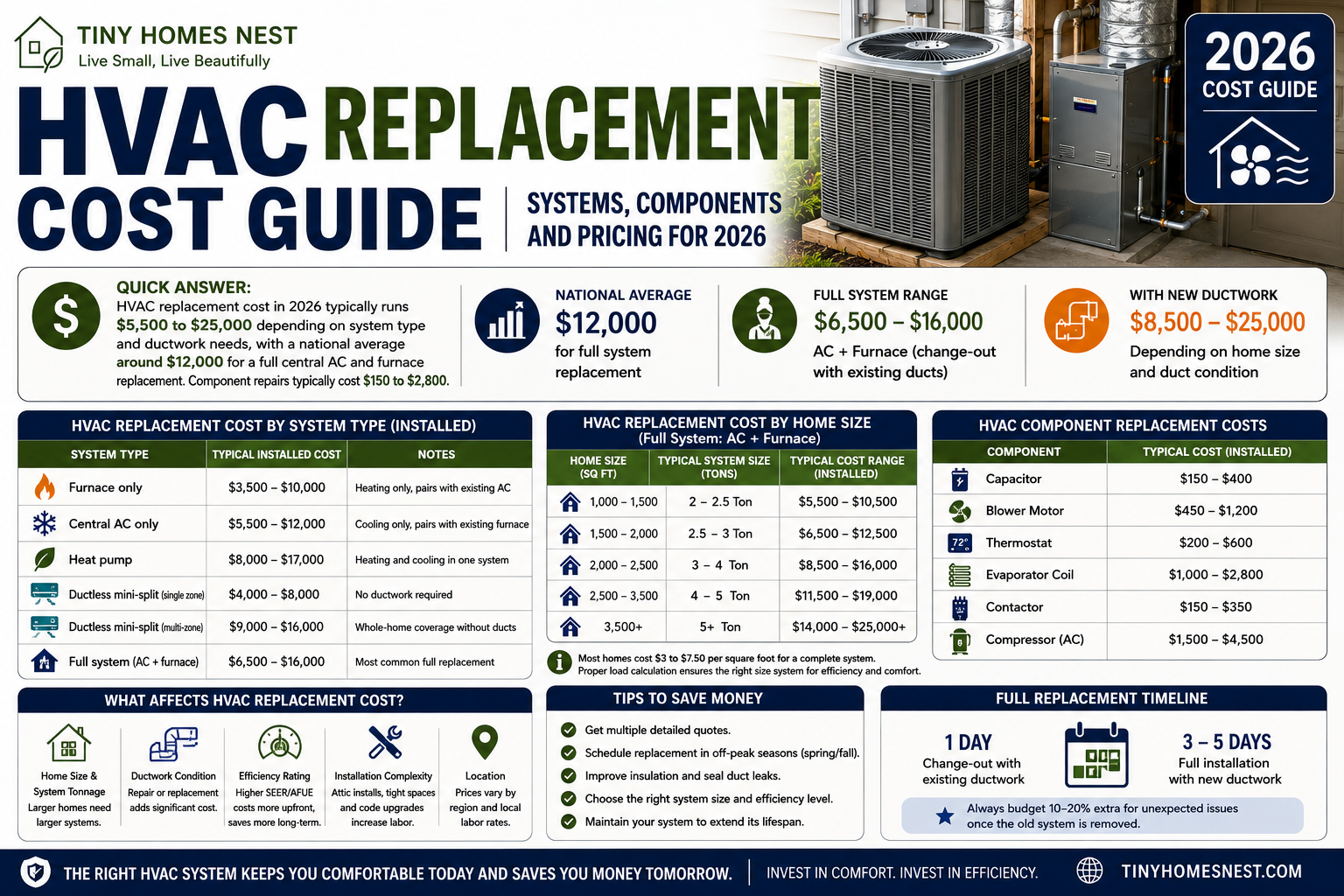
Quick answer: HVAC replacement cost in 2026 typically runs $5,500 to $25,000 depending on system type and whether ductwork needs work, with a national average around $12,000 for a full central AC and furnace replacement. Individual component repairs, capacitors, blower motors and similar parts, typically cost far less, generally $150 to $2,800 depending on the part.
How Much Does HVAC Replacement Cost in 2026? Quick Answer
Full HVAC replacement cost varies enormously depending on exactly what “replacement” means in your situation, which is the single biggest source of confusion when homeowners start comparing quotes. Two contractors can walk through the exact same home and hand you wildly different numbers simply because one assumes a full ductwork replacement and the other does not.
A full system replacement, central air conditioning and a gas furnace together, typically runs $6,500 to $16,000 nationally, with a national average landing around $12,000 based on recent large-sample contractor pricing data. Adding new ductwork pushes the total to $8,500 to $25,000 depending on home size and duct condition. A simpler change-out, replacing just the main components where existing ductwork stays in place, generally costs less and takes about a day rather than the three to five days a full installation with ductwork requires. Knowing which of these three scenarios actually applies to your home is the single most useful thing you can determine before requesting a single quote.
HVAC Replacement Cost by System Type
System type changes both the price and what the system can actually do, which matters more than most homeowners realize when comparing a furnace quote against a heat pump quote. Choosing based on price alone, without considering what each system type actually delivers, is one of the more common regrets homeowners report a year or two after installation.
| System Type | Typical Installed Cost | Notes |
|---|---|---|
| Furnace only | $3,500 to $10,000 | Heating only, pairs with existing AC |
| Central AC only | $5,500 to $12,000 | Cooling only, pairs with existing furnace |
| Heat pump | $8,000 to $17,000 | Heating and cooling in one system |
| Ductless mini-split (single zone) | $4,000 to $8,000 | No ductwork required |
| Ductless mini-split (multi-zone) | $9,000 to $16,000 | Whole-home coverage without ducts |
| Full system (AC plus furnace) | $6,500 to $16,000 | Most common full replacement |
Heat pumps cost more upfront than a standard furnace. They replace two separate systems with one and generally run 35 to 45 percent cheaper to operate, though, since they move heat rather than generating it through combustion. That operating cost difference typically pays back the higher upfront price within five to eight years, depending on local electricity and gas rates in your area. Cold-climate heat pump models have also improved considerably in recent years, making them a realistic option even in regions where they were once considered impractical below freezing.
HVAC Replacement Cost by Home Size
Home size determines system tonnage. Tonnage drives price more directly than square footage alone.
A rough sizing rule puts one ton of cooling capacity per 400 to 600 square feet, meaning a typical 2,000 square foot home usually needs a 3 to 4 ton system, though climate and insulation quality shift that number considerably. Insulation quality specifically deserves attention here, since a poorly insulated home can push the required tonnage up a full size compared to an identical home with proper insulation, adding thousands of dollars to the equipment cost before installation even begins. Installed systems generally cost $2,000 to $3,000 per ton of capacity, so a 3 ton AC-only swap lands near $6,000 while a 4 ton full system runs closer to $11,000 to $16,000. Per square foot, most homes work out to $3 to $7.50 for a complete system. Contractors should size your system using a proper load calculation rather than square footage alone, since roughly half of quoted residential systems end up oversized, which wastes energy and shortens equipment life. An oversized system also short-cycles, turning on and off more frequently than a correctly sized one, which adds wear on components and actually leaves the home feeling less comfortable despite the larger price tag.
Common HVAC Component Replacement Costs
Not every HVAC problem requires full replacement. A large share of homeowners searching for HVAC costs are actually trying to diagnose a single failed part rather than budget for a new system.
| Component | Typical Repair Cost | What It Does |
|---|---|---|
| Capacitor | $150 to $450 | Starts the compressor and fan motors |
| Blower motor | $400 to $1,200 | Circulates air through the ductwork |
| Compressor | $1,200 to $2,800 | The core of the outdoor AC unit |
| Coil (evaporator or condenser) | $650 to $2,000 | Transfers heat during cooling |
| Contactor | $150 to $350 | Switches high-voltage power to components |
| Control board | $200 to $600 | The system’s central electronics |
A failing capacitor or contactor is often mistaken for a full system failure, since both can cause a unit to stop running entirely despite being inexpensive, straightforward repairs. Before agreeing to a full replacement quote, ask specifically whether a technician has diagnosed which component actually failed, since a compressor replacement on an older unit sometimes costs nearly as much as simply replacing the whole system. As a general rule, if a repair quote approaches 50 percent of the cost of full replacement on a system already past 12 to 15 years old, replacement is usually the more financially sound choice over the long run.
Ductwork Replacement Cost
Ductwork condition is one of the biggest hidden cost drivers in any HVAC project. It rarely shows up clearly until a contractor actually inspects the attic or crawl space.
Replacing existing ductwork typically costs $1,400 to $5,600 for an average home, while adding entirely new ductwork where none currently exists generally adds $2,000 to $5,000 to a system replacement. Ducts typically last 10 to 20 years. Homeowners upgrading a system older than 15 years should budget for at least a duct inspection, if not replacement, since leaky or undersized ductwork can undercut even a high-efficiency system’s performance significantly. A brand new, top-tier furnace connected to leaky, undersized ducts will never deliver the efficiency its rating promises, which is exactly why a duct inspection deserves the same attention as the equipment itself during any replacement project.
Commercial HVAC Replacement Cost
Commercial HVAC pricing follows a different structure entirely from residential work, since building size, occupancy and code requirements all scale up together.
Commercial HVAC installation typically runs $15 to $30 per square foot for office space. Recreational buildings generally run $17 to $22 per square foot, well above residential per-square-foot pricing either way. Commercial systems generally require an engineered proposal following ACCA Manual N or ASHRAE load calculation standards rather than a simple rule-of-thumb estimate. That requirement is one reason commercial quotes take longer to prepare than a standard residential bid. Building occupancy type, ventilation code requirements and zoning across multiple areas of a single building all add complexity that a residential system never has to account for.
Tax Credits and Rebates in 2026: What Changed
A detail that catches many 2026 buyers off guard: the federal tax credit many homeowners remember from recent years no longer applies the way it used to.
The federal Section 25C Energy Efficient Home Improvement Credit, which previously offered up to $2,000 for qualifying heat pumps, expired for equipment placed in service after December 31, 2025, following the One Big Beautiful Bill Act signed in mid-2025. Systems installed in 2026 do not qualify for that specific credit. The active federal pathways for 2026 installs are the IRA-funded HOMES and HEAR or HEEHRA rebate programs, which are rolling out on a state-by-state basis, along with state and utility rebates that often stack on top of each other. ENERGY STAR’s federal tax credit page tracks current program status and eligibility requirements, since this area has shifted enough recently that older articles online may still describe incentives that no longer apply in 2026. Given how quickly these programs have changed, confirming current eligibility directly with a contractor or the ENERGY STAR site before budgeting around any specific rebate amount is worth the extra few minutes.
How to Use an HVAC Replacement Cost Calculator
Online HVAC cost calculators give a reasonable planning range, though they cannot replace an actual load calculation performed at your home.
Enter your home’s square footage and climate zone if the calculator asks for them. Treat the resulting number as a starting point rather than a firm quote, though. Spring and fall tend to offer the best pricing, since installers are less busy during these shoulder seasons and often discount jobs by 10 to 15 percent to keep crews working. Get at least three written, itemized quotes that separate equipment cost, labor, ductwork and any electrical work needed. A single lump-sum number makes it impossible to tell whether you are comparing equivalent scopes of work. Ask each contractor directly what brand and efficiency tier their quote assumes, since two bids that look similar in total dollars can represent very different equipment quality once the specifics are compared side by side.
Frequently Asked Questions
How much does HVAC replacement cost on average?
The national average HVAC replacement cost is around $12,000 for a full central AC and furnace system, with most homeowners spending $6,500 to $16,000. Adding new ductwork can push the total to $25,000 for larger homes.
How much does it cost to replace just the AC unit?
Central AC replacement alone typically costs $5,500 to $12,000, assuming the existing furnace and ductwork stay in place and are in good condition.
Is a heat pump more expensive than a furnace?
Yes, upfront. A heat pump typically costs $8,000 to $17,000 compared to $3,500 to $10,000 for a furnace alone. A heat pump replaces both heating and cooling in one system, though. It generally costs less to operate over time as a result.
How much does it cost to fix a broken HVAC capacitor or blower motor?
A capacitor replacement typically costs $150 to $450, while a blower motor replacement generally runs $400 to $1,200. Both are common repairs that do not require replacing the entire system.
Is the federal HVAC tax credit still available in 2026?
The previous $2,000 federal credit for heat pumps expired for systems installed after December 31, 2025. For 2026, IRA-funded HOMES and HEAR or HEEHRA rebate programs are the active federal pathways, alongside state and utility rebates that can still meaningfully lower the cost.
When is the cheapest time of year to replace an HVAC system?
Spring and fall shoulder seasons typically offer the best pricing, since installers have lighter schedules and often discount jobs by 10 to 15 percent to keep crews busy during slower months.
HVAC replacement cost depends almost entirely on whether you actually need a full system or just a single failed component, which is worth confirming with a proper diagnosis before agreeing to any large quote. Get the sizing right, ask about current rebate programs and always request an itemized bid before you commit to a contractor. A little homework upfront routinely saves homeowners thousands of dollars compared to accepting the first quote that arrives.
Have a specific system type or repair question in mind? Drop it in the comments and our team will help you think through the real numbers. Browse our full Home Improvement collection for more room-by-room and system-by-system cost guides as they go live.
Emily Hartman is the founder and lead editor at Tiny Homes Nest. After downsizing into a 340-square-foot home in 2019, she spent years working through zoning rules, financing options and real renovation costs firsthand. That experience is what she now turns into practical, no-fluff guides for buyers and downsizers.