Virtual Interior Design: Cost, How It Works and Top Services Compared
By Emily Hartman, Founder & Lead Editor at Tiny Homes Nest. Tiny home owner since 2019.
Hiring a traditional interior designer used to mean in-home visits, hourly billing and a budget that ruled most people out entirely. Virtual interior design changed that math completely. This guide breaks down what virtual interior design actually costs in 2026, how the process works and which services are worth considering before you upload a single photo of your room. The category has grown fast enough that comparing options now takes real research, since pricing structures, deliverables and even which companies are still operating have all shifted since this space first launched.
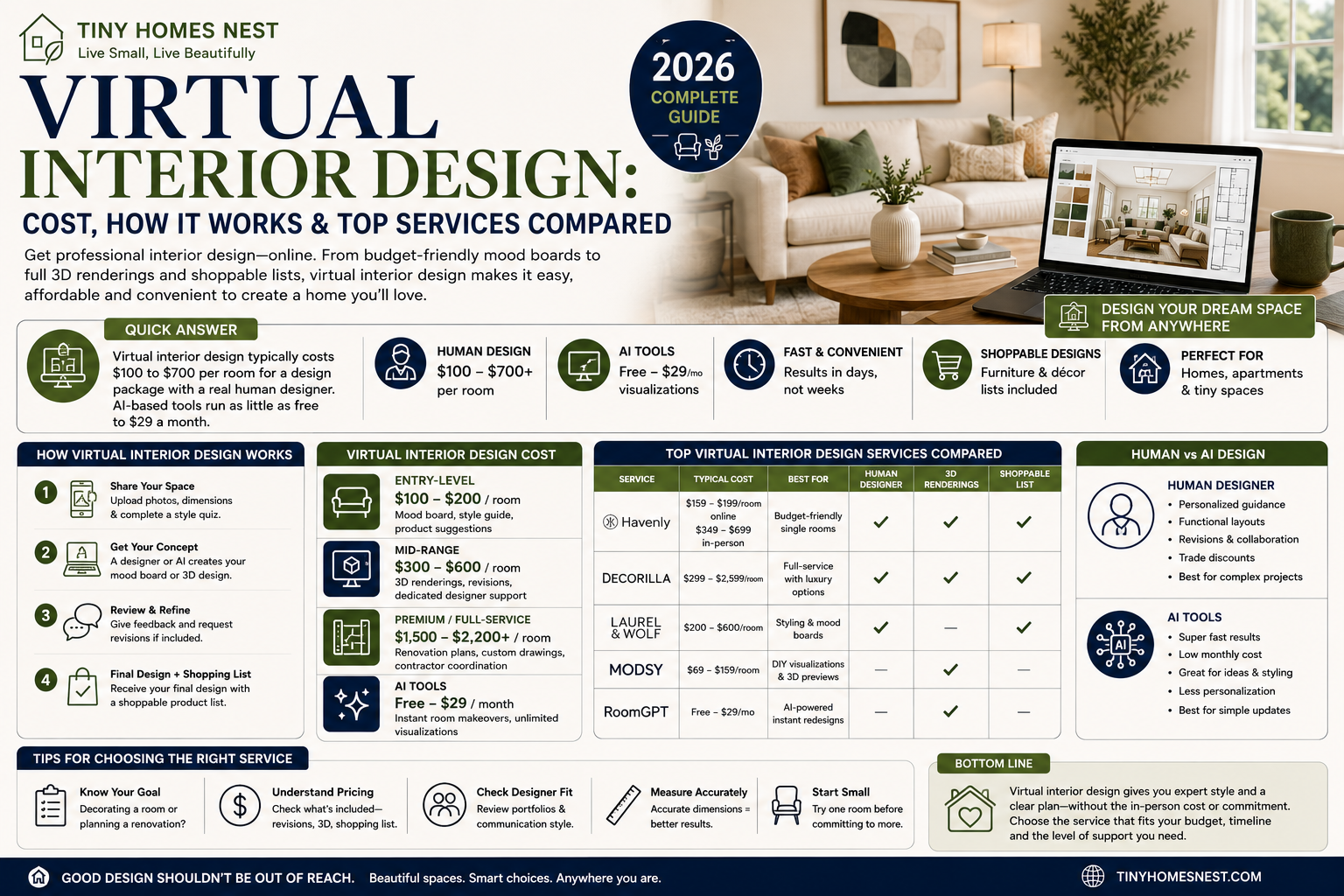
Quick answer: Virtual interior design typically costs $100 to $700 per room for a design package with a real human designer. AI-based visualization tools run as little as free to $29 a month instead. Full-service options like Havenly and Decorilla include mood boards, 3D renderings and shoppable furniture lists, while AI apps trade some of that depth for speed and a much lower price.
What Is Virtual Interior Design? Quick Answer
Virtual interior design replaces in-person designer visits with an online process built around photos, measurements and a style questionnaire.
You typically upload room photos and dimensions, answer questions about your style preferences and budget, then receive a design concept back within days rather than weeks. Some services pair you with a professional human designer. Others use AI to generate a redesigned room image almost instantly. The two approaches solve different problems. Understanding which one you actually need matters more than picking whichever service ranks first in a search. A homeowner exploring paint colors and a homeowner planning a full furniture replacement are, in practice, shopping for two very different products even though both fall under the same “virtual interior design” label.
How Much Does Virtual Interior Design Cost?
Virtual interior design cost splits into three rough tiers. The difference between them comes down to how much human expertise and follow-through is actually included.
Entry-level packages, typically a style quiz plus a mood board and product suggestions, generally run $100 to $200 per room. Mid-range packages that add full 3D renderings and dedicated designer support typically cost $300 to $600 per room. Premium tiers built for renovations, custom architectural drawings and contractor coordination can reach $1,500 to $2,200 or more per room. AI-only visualization tools sit outside this structure entirely, often running $29 a month or less for essentially unlimited room redesigns. What you give up at that price point is the shopping list, trade discounts and human accountability a full-service package includes. Comparing these tiers on price alone misses the point, since a $150 mood board and a $2,000 renovation package are not competing for the same customer in the first place. Think of the tiers as answering different questions rather than as a simple ladder of quality.
How Virtual Interior Design Actually Works
The process looks similar across most services, even though pricing and deliverables vary considerably between them.
Most platforms start with a style quiz to establish your taste, followed by a request for room photos and exact measurements. A designer or an AI system then proposes an initial concept, usually as a mood board or a rendered image. Full-service platforms typically allow a round or two of revisions before delivering a final concept, often paired with a shoppable list of the furniture and decor featured in the design. Response time ranges from about 10 seconds for AI tools to three to five weeks for premium human-designer packages handling architectural changes. Knowing which end of that range your specific project needs helps set realistic expectations before you pay for anything, since a renovation-scale project promised in a weekend is usually a sign the service is skipping steps rather than working unusually fast.
Top Virtual Interior Design Services Compared
A handful of platforms dominate this category. Each one targets a genuinely different type of project rather than competing head to head on price alone. Reading past the marketing homepage to the actual package details usually reveals which platform fits your project far faster than a generic star rating ever could. The table below reflects publicly listed 2026 pricing, though most services run seasonal promotions worth checking directly before you commit.
| Service | Typical Cost | Best For |
|---|---|---|
| Havenly | $159 to $199 per room online, $349 to $699 in-person | Budget-friendly single rooms with a real designer |
| Decorilla | $299 to $2,219+ per room | Renovations, competing designer concepts, trade discounts |
| Spacejoy | Price varies, 3D renderings included | Fast turnaround, no kitchen or bath planning |
| AI tools (general) | Often $29/month or less | Instant visualization, no shopping list or contractor coordination |
Havenly offers the most accessible entry point, including a free AI tier before you commit to a paid package with a human designer. Decorilla differentiates itself by showing two competing concepts from different designers before you choose a direction. Its higher tiers also add real trade discounts on furniture, sometimes 5 to 45 percent off retail, which can offset a meaningful share of the design fee on a larger project. Spacejoy focuses on speed, typically delivering within 7 to 10 days, though it does not currently offer kitchen or bathroom planning the way Decorilla does. Modsy, once a major name in this space, shut down in 2022. Former Modsy customers looking for the closest equivalent experience generally land on Havenly or Decorilla instead, depending on whether budget or competing concepts matters more to their decision.
AI Tools and Virtual Design Apps
AI-based room design tools represent the newest and fastest-growing corner of this category. They solve a narrower problem than a full-service platform does.
Upload a photo, select a style and most AI tools generate a redesigned version of your actual room within seconds rather than days. Pricing typically runs free to around $29 a month, dramatically cheaper than any human-designer package. The trade-off is real. AI tools excel at visualization and style exploration but generally cannot provide a shoppable furniture list with trade pricing, coordinate with contractors or produce the technical floor plans a renovation actually requires. Software platforms built more for DIY room planning, rather than AI generation specifically, occupy a similar budget-friendly space. These work well for homeowners who want to experiment with layouts themselves before committing to any paid service. Treat an AI render as a starting concept rather than a finished plan, since the tool has no way to confirm a piece of furniture will actually fit through your doorway or clear a light switch on the wall.
Is Virtual Interior Design Worth It?
The honest answer depends entirely on the scope of what you are trying to accomplish, not on which service has the best marketing.
For a single room refresh, new furniture, a fresh layout, updated decor, a virtual service genuinely competes with hiring a local designer at a fraction of the cost and turnaround time. For a renovation involving moved walls, new plumbing locations or structural changes, the premium tiers from a service like Decorilla generally deliver more value than a budget virtual package can. The same is often true of a traditional in-person designer for that scope of work. Our residential interior design guide breaks down local firm fee structures and how to vet a designer if that traditional route ends up being the better fit. The American Society of Interior Designers, the field’s primary professional association, notes that hiring a qualified design professional protects against costly mistakes on projects involving your home’s health, safety and structural systems. That distinction is worth keeping in mind before assuming any $100 package covers every type of project equally well. A mood board can guide a paint color decision perfectly well. It has no business guiding a decision about moving a load-bearing wall.
Virtual Interior Design for Small Spaces and Tiny Homes
Virtual design services translate especially well to small and tiny homes, since the core challenge, fitting real function into limited square footage, is exactly the kind of problem a designer can solve remotely with accurate measurements.
Multi-functional furniture, built-in storage solutions and scaled-down layouts all photograph and measure easily. A virtual designer working from photos and dimensions loses very little compared to an in-person visit in this specific context as a result. Our interior design styles guide covers which aesthetic approaches, Japandi and Scandinavian in particular, tend to work best in compact spaces if you want a starting point before your first virtual consultation. Bring exact measurements to that first consultation regardless of which service you choose, since an inaccurate room dimension causes more wasted revisions in a small space than in a larger one where furniture has more room to be slightly miscalculated. A single inch of error matters far more in a 250 square foot room than it does in a 2,500 square foot one.
How to Prepare for a Virtual Design Consultation
A handful of preparation steps meaningfully improve the result you get back from any virtual design service, regardless of which platform you choose.
Measure your room precisely, including ceiling height, window and door placement and any architectural quirks like an angled wall or a low beam. Take photos in natural daylight from multiple angles, including close-ups of anything you want to keep, such as existing furniture or a fireplace. Set a real budget range before you start, since a designer working blind on cost expectations tends to propose furniture well outside what you actually intended to spend. Save five to ten reference images that represent your taste, since a scattered mix of fifty unrelated images makes it harder for a designer or an AI tool to identify a consistent direction. Note which existing pieces are staying and which are up for replacement too, since ambiguity here is one of the most common reasons a first concept misses the mark entirely.
Frequently Asked Questions
How much does virtual interior design cost?
Virtual interior design typically costs $100 to $700 per room for a package with a human designer, while AI-based visualization tools often run free to about $29 a month. Premium renovation-focused packages can exceed $2,000 per room. The right tier depends on scope far more than personal preference for one brand over another.
What is the difference between virtual interior design and an app like Homestyler?
Virtual interior design services like Havenly and Decorilla pair you with a human designer who produces a finished concept. Planning apps and AI tools let you experiment with layouts and styles yourself, generally at a lower cost but without professional guidance.
Is Modsy still available?
No, Modsy shut down in 2022. Former Modsy users generally move to Havenly for a similar lower-cost human-designer experience or Decorilla for a comparable full-service option with competing designer concepts.
Can virtual interior design work for a small or tiny home?
Yes, often especially well, since small spaces depend heavily on accurate measurements and functional furniture choices that a designer can address remotely just as effectively as in person.
What do I need to provide for a virtual design consultation?
Most services require room photos, exact measurements and answers to a style questionnaire. Providing a real budget range and five to ten reference images upfront typically produces a more accurate first concept.
Are AI interior design tools as good as hiring a real designer?
For visualization and style exploration, AI tools are fast and inexpensive. For renovations, contractor coordination or a shoppable list with trade pricing, a human-designer service still generally delivers more complete results. Most homeowners end up using both at different stages, an AI tool early on to narrow down direction and a human designer later to execute the final plan.
Virtual interior design has matured from a novelty into a genuinely practical option for most single-room projects, with pricing and turnaround times that beat traditional in-person design in almost every comparison. Match the service to your actual project. A quick AI visualization works for exploring ideas. A mid-tier human package suits a real room refresh. A premium tier makes sense for anything involving structural change. The format works for nearly any budget once matched correctly, which is the real advantage this category has over the traditional, one-size-fits-all design retainer it is steadily replacing.
Have a specific room or service in mind? Drop it in the comments and our team will help you think through which option actually fits your project.