
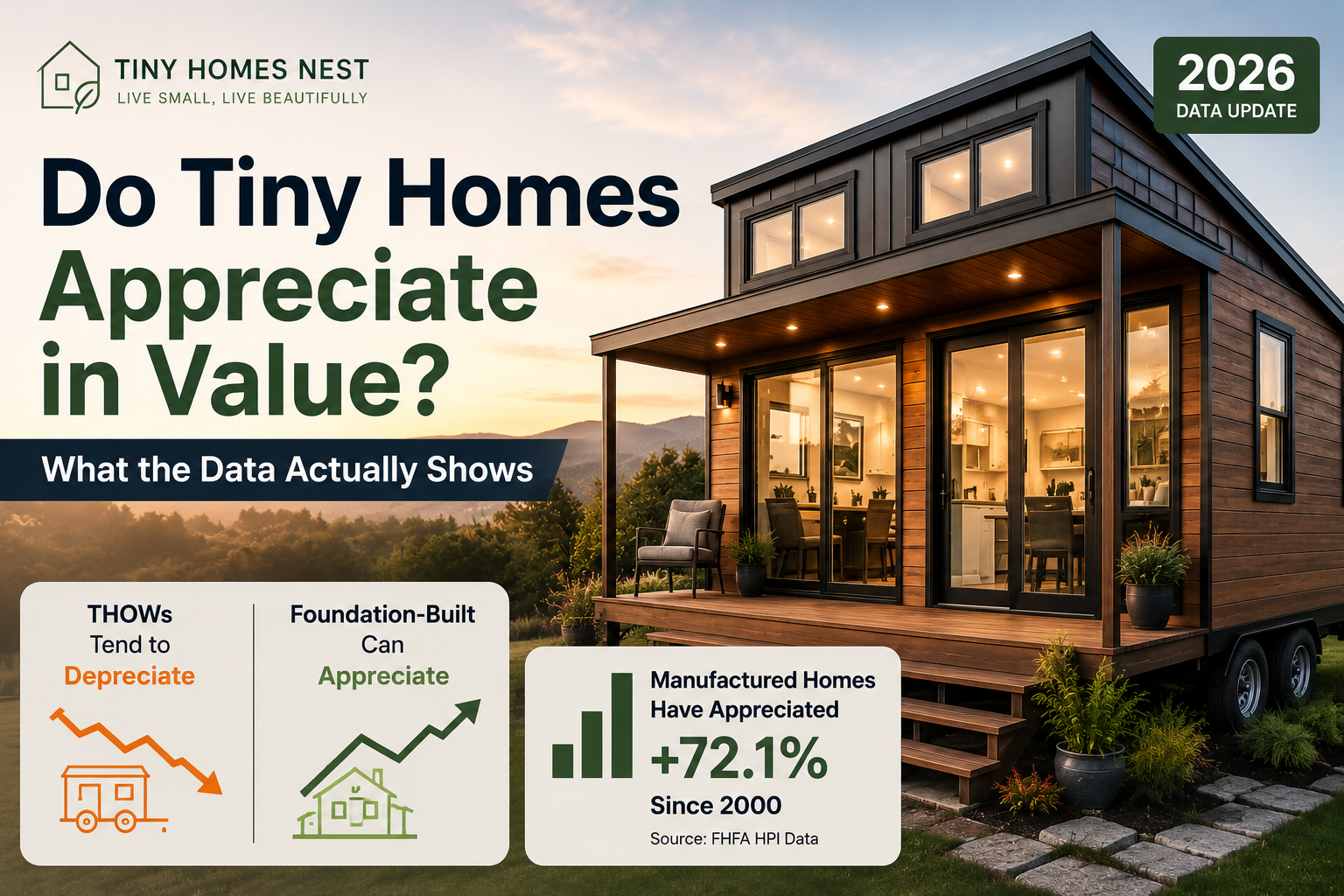
Do Tiny Homes Appreciate in Value? What the Data Actually Shows
By Emily Hartman, Founder & Lead Editor at Tiny Homes Nest. Tiny home owner since 2019.
“Tiny homes are basically RVs, they lose value the second you drive off the lot.” You have probably heard some version of that claim. Like most sweeping statements about tiny living, it is true for some tiny homes and flatly wrong for others. This guide walks through what actually happens to tiny home value over time, using real housing data rather than internet folklore. It also covers a tax detail most tiny home owners never think to ask about until they are already trying to sell.
Quick answer: Whether a tiny home appreciates or depreciates depends almost entirely on how it is classified and whether it sits on owned land. Tiny homes on wheels generally depreciate like vehicles. Foundation-built and manufactured tiny homes classified as real property on owned land have appreciated at rates close to traditional site-built homes over the past two decades.
Do Tiny Homes Appreciate in Value? Quick Answer
There is no single answer that covers every tiny home. Any guide that gives you one flat percentage is oversimplifying a genuinely complicated picture. The honest answer splits cleanly along one line: personal property versus real property.
A tiny home titled as personal property, meaning it sits on leased land, has no permanent foundation or carries a vehicle title rather than a real estate deed, tends to depreciate the way a car or RV does. A tiny home classified as real property, meaning it sits on a permanent foundation on land you own with a proper deed, behaves much more like traditional housing. Everything else in this guide explains why that single distinction matters more than size, finish level or brand.
The Single Factor That Decides Appreciation vs. Depreciation
Buyers spend enormous energy comparing floor plans and finishes, then barely think about classification, even though classification is the single biggest driver of long-term value. A five-thousand-dollar upgrade to countertops gets far more attention during shopping than a decision that can affect resale by tens of thousands of dollars down the line.
Personal property depreciates for a structural reason, not because tiny homes are inherently a bad purchase. Vehicles, RVs and anything titled similarly lose value predictably because the market prices them against a depreciation curve from day one, the same way a car loses value the moment it leaves the dealership. Real property, by contrast, is priced against land value and local market conditions. Those conditions have historically trended upward over long time horizons across most of the United States, even accounting for occasional regional downturns.
This is not a tiny-home-specific quirk. It is exactly how the broader manufactured housing market behaves too. Tiny homes largely inherit those same rules once you understand which category a specific home falls into.
Real Property vs. Personal Property: Why This Classification Matters So Much
Three things typically determine which side of the line a tiny home falls on: the foundation, the land and the title.
A permanent foundation, as opposed to wheels or temporary blocking, is usually required for real property classification. Owned land, rather than a leased lot in a community or park, is the second requirement, since you cannot build equity in land you do not own. A real estate deed, rather than a vehicle title through your state’s DMV, is the third and often overlooked requirement. Miss any one of these three and a tiny home typically defaults to personal property treatment, regardless of how nice the interior finishes are. A builder or seller may not volunteer this distinction unprompted, so it is worth asking directly rather than assuming a “foundation” model automatically qualifies.
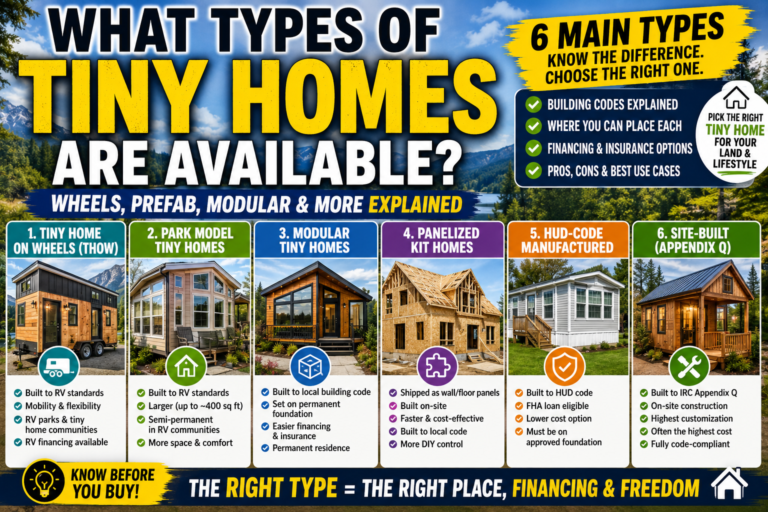
Our guide to types of tiny homes breaks down exactly which construction categories, from THOWs to HUD-code manufactured homes to site-built Appendix Q homes, tend to land on each side of this classification. That guide is worth reading before you assume any specific model you are considering will appreciate.
How Tiny Homes on Wheels Actually Perform
Tiny homes on wheels are the category most people picture when they hear “tiny home,” and they are also the category that most closely matches the RV depreciation stereotype.
A THOW typically loses meaningful value in its first year, often in the range of 10 to 20 percent, similar to how a new RV depreciates once it leaves the manufacturer. This happens regardless of build quality or finish level, since the depreciation is driven by classification and market comparables rather than construction. A well-built, well-maintained THOW can still hold value better than a poorly built one over time. Neither is likely to appreciate the way a house on owned land can, no matter how well it is cared for.
None of this makes a THOW a bad choice. It simply means you should budget for it the way you would budget for any vehicle purchase, expecting genuine usage value and lifestyle benefit rather than treating it as an appreciating asset. Plenty of owners choose a THOW specifically for mobility and lower upfront cost, fully aware that the trade-off is limited appreciation. They consider that trade worthwhile for what the home actually delivers day to day. Many never intend to sell in the first place.
How Foundation-Built and Manufactured Tiny Homes Perform
The picture changes substantially once a tiny home sits on a permanent foundation and qualifies as real property.
Federal Housing Finance Agency data on manufactured housing shows that homes classified as real property on owned land appreciated by roughly 211.8 percent between 2000 and 2024, essentially matching the 212.6 percent appreciation of traditional site-built homes over the same period. That works out to an annual appreciation rate close to 5 percent for both categories. This figure directly contradicts the old assumption that manufactured and factory-built homes are automatically depreciating assets. Separate industry data on manufactured home resale supports the same conclusion. More than 65 percent of manufactured homeowners report their home’s value has either increased or stayed the same since purchase, with roughly 37 percent reporting a direct increase.
The takeaway is not that every foundation-built tiny home will match these averages exactly. It is that the depreciation myth applied broadly to anything “factory-built” or “tiny” simply does not hold up once a home meets the real property criteria.
Does Land Ownership Change Everything?
Land ownership is arguably the single most important variable in this entire discussion, more important than the structure itself in many cases.
A tiny home on rented land, even one built to HUD code with a technically permanent foundation, still depends on the community or park owner’s decisions. Lot rent increases, park closures and community rule changes can all suppress resale value regardless of how the home itself is classified. A tiny home on land you own removes that risk entirely and lets the land’s own appreciation contribute to your overall equity. That is the same dynamic that drives value in traditional real estate. Even a modest, older home tends to hold up better on owned land than a newer, nicer one does on a leased lot, simply because the land underneath is doing most of the work.
If building long-term equity matters to you, prioritizing land ownership over a bigger or more finished structure is usually the smarter decision. A modest tiny home on owned land tends to outperform a nicer tiny home on rented land over a long enough time horizon, simply because one is tied to an appreciating asset and the other is not.
Tax Considerations When You Sell
A detail many tiny home owners do not realize: the IRS primary residence capital gains exclusion is not limited to conventional houses.
According to the IRS, the home sale tax exclusion can apply to any property used as your main home. IRS guidance explicitly includes mobile homes and trailers in that definition, provided you meet the ownership and use tests. In practice, that means a tiny home used as your genuine primary residence for at least two of the five years before you sell it may qualify for the same capital gains exclusion as a traditional house, up to $250,000 for single filers or $500,000 for married couples filing jointly. This applies regardless of whether the underlying structure would otherwise be classified as personal or real property for appreciation purposes. It is worth discussing with a tax professional before you assume a tiny home sale gets no favorable tax treatment at all, especially if a meaningful gain seems likely.
How to Maximize Resale Value in a Tiny Home
A handful of decisions, made early, meaningfully improve resale outcomes regardless of which category your tiny home falls into.
Choosing real property classification from the start, when it is financially possible, sets up the strongest long-term position. Maintaining the home well matters more in this category than in standard housing, since buyers evaluating a smaller, less conventional property tend to scrutinize condition more closely. Keeping thorough maintenance records gives a future buyer or an appraiser concrete evidence of care rather than just a visual impression. For THOWs specifically, protecting the trailer and running gear matters as much as the living space, since mechanical condition affects resale the way it would for any vehicle.
Even within the luxury tier, the same rule applies. Premium finishes do not override classification. Our guide to luxury tiny homes covers this in more detail if you are weighing higher-end upgrades specifically for their resale impact.
Is a Tiny Home a Good Investment? Realistic Expectations
The honest framing is that a tiny home is rarely a pure investment vehicle the way a rental property or a stock portfolio might be. For most buyers, the real return is lifestyle value, lower housing costs and flexibility, not appreciation. Treating a tiny home purchase primarily as a financial bet, rather than a housing decision with a financial dimension, tends to set buyers up for disappointment regardless of which category the home falls into.
That said, a foundation-built tiny home on owned land can genuinely function as a reasonable store of value, backed by real appreciation data rather than wishful thinking. A THOW functions more like a vehicle that happens to be livable, with real usage value but limited appreciation potential. Neither framing is wrong. They are simply describing two different products that both get called “tiny homes.” Knowing which one you are actually buying, before you sign anything, is the entire point of this guide.
Frequently Asked Questions
Do tiny homes appreciate in value?
It depends entirely on classification. Foundation-built and manufactured tiny homes classified as real property on owned land have appreciated at rates close to traditional homes, while tiny homes on wheels generally depreciate similarly to RVs.
Do tiny homes on wheels lose value like RVs?
Yes, typically. A THOW often loses 10 to 20 percent of its value in the first year, following a depreciation pattern similar to a new RV or vehicle, regardless of build quality.
Does land ownership affect tiny home value?
Significantly. A tiny home on owned land with a permanent foundation can participate in land appreciation. The same home on rented land depends on lot rent, park rules and community stability instead.
Can you avoid capital gains tax when selling a tiny home?
Possibly, if the tiny home qualifies as your primary residence and you meet the IRS ownership and use tests. The home sale exclusion explicitly covers mobile homes and trailers used as a main home, not just conventional houses.
Is buying a tiny home a good financial investment?
It depends on the type and classification. A foundation-built home on owned land can function as a reasonable store of value, while a THOW is better thought of as a lifestyle purchase with vehicle-like depreciation rather than a wealth-building asset.
What is the difference between real property and personal property for a tiny home?
Real property generally requires a permanent foundation, owned land and a real estate deed. Personal property typically applies to homes with a vehicle title, no permanent foundation or a location on rented land. It depreciates more like a vehicle as a result.
The internet’s blanket claim that “tiny homes always lose value” is simply wrong. The opposite claim that they always appreciate is equally wrong. The real answer lives in classification, land ownership and how the home is actually used, not in the size of the structure itself. Ask the classification question before you ask almost anything else, since every other decision in this guide flows from that one answer.
That wraps up our core tiny homes series. Our complete tiny homes guide ties cost, types, buying channels and now value together in one place if you want the full picture before you commit to a purchase. Still have a question this series did not answer? Drop it in the comments and our team will help you work through it.
Emily Hartman is the founder and lead editor at Tiny Homes Nest. After downsizing into a 340-square-foot home in 2019, she spent years working through zoning rules, financing options and real renovation costs firsthand. That experience is what she now turns into practical, no-fluff guides for buyers and downsizers.




One Comment