
Residential Interior Design: Cost, Services and How to Hire a Firm
By Emily Hartman, Founder & Lead Editor at Tiny Homes Nest. Tiny home owner since 2019.
Hiring a residential interior designer sounds like a luxury reserved for six-figure renovations, until you realize a single-room consultation can cost less than a nice dinner out. This guide breaks down what residential interior design actually costs in 2026, how firms structure their fees and what separates a legitimate design professional from someone just borrowing the title. Pricing in this category has genuinely shifted in recent years too, with hourly rates climbing 15 to 25 percent since 2022 as demand recovered and AI tools reshaped how some firms structure their early-stage work.
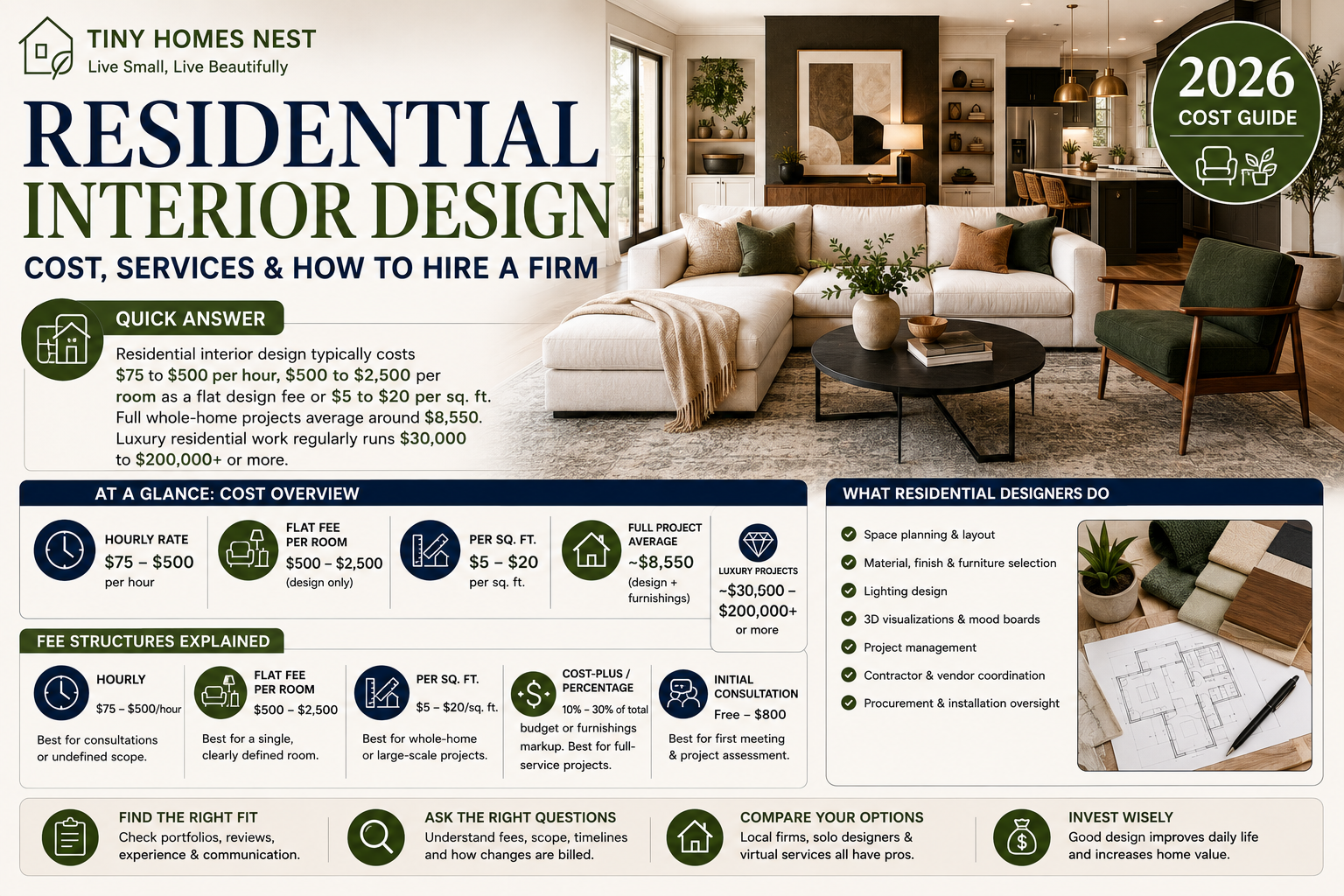
Quick answer: Residential interior design typically costs $75 to $500 per hour, $500 to $2,500 per room as a flat design fee or $5 to $20 per square foot for larger projects. Full whole-home projects average around $8,550. Luxury residential work regularly runs $30,000 to $200,000 or more once furnishings and construction oversight are included.
What Is Residential Interior Design? Quick Answer
Residential interior design covers the planning, layout and finishing decisions for private homes, distinct from commercial design work done for offices, retail spaces or hospitality venues.
A residential interior designer typically handles space planning, material and furniture selection, lighting design and coordination with contractors when a project involves construction. Some designers work solo. Others operate as part of a larger firm with multiple designers, project managers and in-house resources for sourcing furniture and materials. The scope of what “residential interior design” includes varies enormously between a single-room refresh and a full custom home build. That range is exactly why pricing in this category spans such a wide spectrum. A homeowner comparing a $500 quote against a $50,000 quote is often comparing two entirely different scopes of work rather than two firms competing for the same project.
How Much Does Residential Interior Design Cost?
Residential interior design cost depends far more on fee structure and project scope than on any single flat number a homeowner can budget against upfront. Even two firms quoting the exact same project can land on very different totals once their underlying pricing model is factored in.
Hourly rates typically run $75 to $500 per hour, with most residential designers charging between $100 and $250. A flat fee for a single room’s design work generally costs $500 to $2,500, not including furniture. Per-square-foot pricing, more common on larger projects, typically runs $5 to $20 per square foot. A full project, design plus furnishings, averages around $8,550 nationally, with a typical range of $2,055 to $15,256. Luxury and whole-home projects regularly land between $30,000 and $80,000 for mid-range work, climbing past $200,000 for high-end residences once construction oversight and premium furnishings are included. Experience level moves the hourly figure considerably too. A junior designer might charge $75 an hour, while a nationally recognized principal in a major city can bill $1,000 or more.
Residential Interior Design Fee Structures Explained
Firms structure fees differently depending on project size. Most established studios actually combine more than one model on a single project rather than sticking to just one throughout an engagement. Understanding these models in advance turns a confusing quote into a straightforward comparison.
| Fee Structure | Typical Rate | Best For |
|---|---|---|
| Hourly | $75 to $500/hour | Consultations, undefined scope |
| Flat fee per room | $500 to $2,500 (design only) | A single, clearly defined room |
| Per square foot | $5 to $20/sq ft | Whole-home or large-scale projects |
| Cost-plus or percentage | 10 to 30 percent of total budget or a furnishings markup | Full-service projects with procurement |
| Initial consultation | Free to $800 | First meeting and project assessment |
A common real-world structure combines a flat design fee with cost-plus pricing on furnishings and hourly billing for any additional site visits beyond the original scope. Ask directly which model or combination of models a firm uses before signing anything. A quote that sounds low on an hourly basis can still end up expensive once furnishing markups are added on top. Requesting a written estimate of total hours expected, even for hourly billing, gives you a real number to plan around rather than an open-ended commitment.
Luxury and High-End Residential Interior Design
Luxury residential interior design operates on a different scale entirely, both in scope and in how firms price their work.
High-end firms frequently charge $200 to $500 or more per hour, with name designers in major coastal markets commanding the top of that range. Whole-home luxury projects commonly run $50,000 to $200,000 or beyond once fees, construction oversight and premium furnishings are combined. The trade discount that comes with a full-service luxury firm, often 20 to 40 percent off retail furniture and materials, can offset a meaningful share of the design fee on a large enough project. It rarely erases the gap entirely on a modest one, though. Geographic location moves luxury pricing considerably. Major coastal markets typically command a 20 to 40 percent premium over secondary markets for comparable work. A firm’s reputation and past client list also factor into pricing at this tier in a way that matters less at the entry level, where credentials and portfolio quality carry relatively more weight than name recognition alone. A homeowner shopping purely on price at the luxury tier often ends up disappointed, since the premium at this level is paying for judgment and connections built over years, not just extra hours billed.
What Residential Interior Design Firms Actually Do
Understanding the actual scope of services helps explain why fees vary so widely between a $500 flat-fee room and a $50,000 whole-home project.
A typical engagement starts with space planning and a style consultation, then moves into material, furniture and lighting selection. Firms managing construction-adjacent work also coordinate directly with contractors, electricians and other trades. That coordination service adds real value on any project involving structural changes. Full-service firms typically handle procurement as well, ordering furniture and materials on the client’s behalf, often at trade pricing unavailable to the general public. Smaller or hourly-billed engagements usually stop at the planning and selection phase. Procurement and contractor coordination is left to the homeowner in that case. Knowing exactly which of these phases a specific quote covers, rather than assuming “design services” means the same thing across every firm, prevents the single most common source of scope confusion in this industry. A quote that looks like a bargain on paper sometimes turns out to cover only the planning phase, with procurement and coordination billed entirely separately once the project actually begins.
Firms vs. Solo Designers vs. Virtual Services
The residential interior design market splits into three genuinely different service models. Picking the wrong one for your project is a common source of buyer’s remorse.
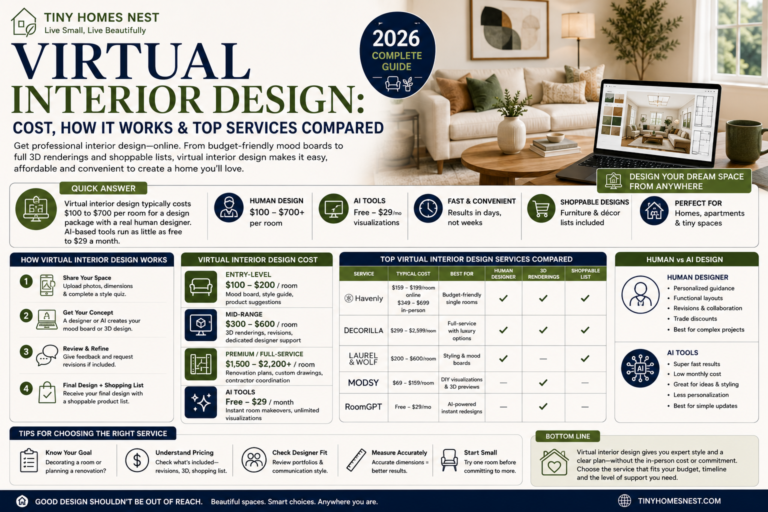
Traditional firms and solo designers meet with you in person, which matters most for larger projects involving construction, custom millwork or complex spatial problems a photo cannot fully capture. Virtual and online design services trade the in-person visit for a lower price and faster turnaround, typically working well for single-room refreshes rather than full renovations. Our virtual interior design guide breaks down specific platforms, pricing and how that process compares directly if a lower-cost, remote option might fit your project better than a traditional local firm. Solo designers sit somewhere between the two extremes, often charging less than a large firm while still offering the in-person visits a virtual service cannot provide, though typically with less bandwidth to handle multiple large projects simultaneously.
How to Find and Vet a Residential Interior Design Firm
A handful of questions separate a legitimate residential interior design firm from someone using the title loosely.
Ask about licensing or professional membership status, since requirements vary by state but genuine credentialing organizations exist specifically to vet practicing designers. The American Society of Interior Designers maintains a searchable directory of qualified residential design professionals, a useful starting point regardless of your location. Request a portfolio of completed residential projects similar in scope to yours, not just polished photos from a single showcase job. Confirm the fee structure and get it in writing before any work begins, including exactly what counts as a billable revision versus what is included in the original scope. A firm that hesitates to answer any of these questions directly is worth reconsidering before you commit a deposit. Checking recent client references, not just the two or three a firm chooses to volunteer, rounds out a reasonable vetting process before any contract gets signed.
Residential vs. Commercial Interior Design
The line between residential and commercial interior design comes down to who uses the space and under what regulations, which changes both the design process and the fee structure.
Commercial designers typically charge somewhat lower hourly rates than residential specialists, generally $175 to $275 per hour compared to a $200 to $300 median for residential work. Commercial projects often involve far more square footage overall, though, which changes the total project economics considerably even when the hourly rate looks lower on paper. Building codes, accessibility requirements and life-safety regulations weigh more heavily on commercial projects, which shifts more of a commercial designer’s time toward compliance rather than personal style. A designer specializing in residential work brings a different skill set focused on daily livability and personal taste. This is exactly why firms working in both categories often staff them with different specialists entirely. A strong commercial portfolio does not automatically predict success on a private home either.
Frequently Asked Questions
How much does residential interior design cost on average?
A full project including design and furnishings averages around $8,550, with a typical range of $2,055 to $15,256. Hourly rates run $75 to $500. Flat fees per room typically cost $500 to $2,500 for design work alone. Luxury whole-home projects sit well above all of these figures once furnishings and construction oversight enter the picture.
What is the difference between residential and commercial interior design?
Residential design focuses on private homes and personal livability, while commercial design serves offices, retail and hospitality spaces under stricter code and accessibility requirements. The two specialties often require different skill sets and staffing within larger firms.
Is it cheaper to hire a local designer or use a virtual service?
Virtual and online interior design services are generally less expensive and faster than a traditional local firm, particularly for single-room projects. Local firms tend to deliver more value on larger projects involving construction or complex spatial planning.
How much does a luxury residential interior designer cost?
Luxury and high-end residential designers frequently charge $200 to $500 or more per hour, with whole-home luxury projects commonly running $50,000 to $200,000 or beyond once fees, furnishings and construction oversight are included.
What should I ask before hiring a residential interior design firm?
Ask about licensing or professional membership, request a portfolio of similarly scoped residential projects and get the fee structure in writing before work begins. Confirm exactly what counts as a billable revision versus what falls within the original project scope. A firm confident in its process will have clear answers ready for all four questions.
Do residential interior designers make money on furniture markups?
Many do, typically through a cost-plus model charging 20 to 40 percent over wholesale on furniture and materials they source on your behalf. Ask directly whether a firm uses this model and request receipts to confirm the actual amount spent. This model is entirely standard in the industry, so the goal is transparency rather than avoiding it altogether.
Residential interior design cost varies more by fee structure and project scope than by any single number worth memorizing. Understanding which pricing model a firm actually uses matters more than chasing the lowest hourly rate you can find. Matching that firm’s specialty to your specific project matters just as much, since the best-reviewed luxury designer in your city is rarely the right fit for a single-room budget refresh. The reverse holds just as true for a full custom build.
Have a specific project or budget range in mind? Drop it in the comments and our team will help you think through which service model actually fits.


One Comment